

The Attention Economy Has a Calendar Problem and This Weekend Is the Breaking Point
Few days in sports history can match July 4, 2026 for sheer concentration of live premium properties. In a single 24-hour window, five of the world’s most commercially significant sports properties compete simultaneously for global fan attention, broadcaster airtime, and sponsor activation budget. That collision is not an accident. It is the predictable collision of independently rational scheduling decisions made by federations, circuits, and rights holders who have never been required to coordinate. The result is a live stress test of the attention economy, and the data it generates could provide insights into how global sports are scheduled, packaged, and sold for the next decade.
The question is not whether July 4-5 will be extraordinary. It will be. The question is whether extraordinary means abundant, or cannibalistic.
What Is Actually Competing on July 4
The collision is more precise than the headline suggests. Consider the European afternoon window of Saturday, July 4, between 12:00 and 18:00 CEST:
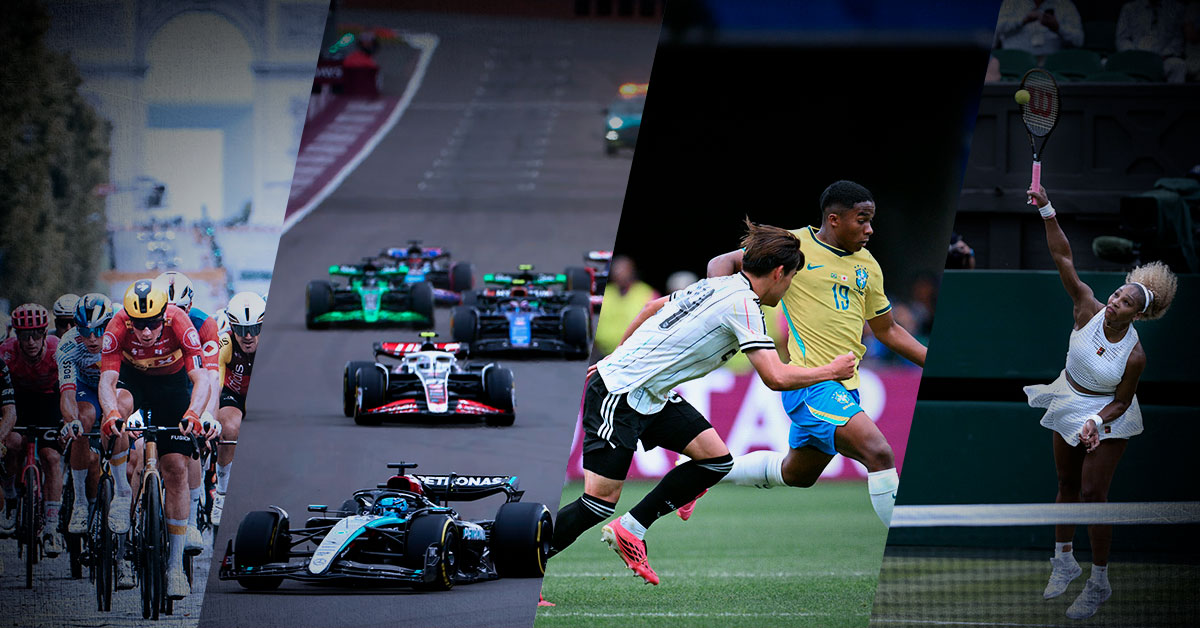
At 12:00 BST (13:00 CEST), the F1 British Grand Prix Sprint race goes live from Silverstone: Kimi Antonelli, George Russell, and Lewis Hamilton racing on home soil, with the championship battle tightening. At 16:00 BST (17:00 CEST), F1 qualifying for the main race follows. At 17:05 CEST, the Tour de France Grand Départ fires off from Barcelona’s Parc del Fòrum, a 19.7 km team time trial threading through the Gothic Quarter, past the Sagrada Família, and up Montjuïc. It is the first stage-opening TTT in the Tour since 1971. Simultaneously, in the United States, the World Cup Round of 16 is underway: Canada vs. Morocco kicks off at 1:00 PM ET (19:00 CEST) in Houston.
Wimbledon‘s second week is in full swing. The ICC Women’s T20 World Cup finals are on. Formula E is racing in Shanghai. The Eugene Diamond League track meet is live in Oregon. And across North America, the largest simultaneous live sports audience in US history is arguably available, July 4 Independence Day weekend, with a FIFA World Cup knockout match broadcast on FOX to a captive domestic market that may never see this combination again.
Every one of these properties would, in a normal year, represent a standalone premium event. On July 4-5, 2026, they are all fighting for the same eyeballs, the same remote control, and the same sponsor dollar.
The Viewership Arithmetic: A Zero-Sum Attention Market
Sports broadcasters and federation media teams will be watching July 4-5 more closely than any weekend this year. The reason is structural: viewership data from this weekend will provide the clearest evidence yet of how sports fans allocate attention under genuine scarcity, and whether the assumption that “rising tides lift all boats” in premium live sport still holds.
The Tour de France‘s Barcelona Grand Départ was strategically positioned by ASO director Christian Prudhomme to capture the American audience on Independence Day weekend. The July 4 start date was a deliberate choice to expand NBC’s broadcast window into the US market. The team time trial format (dramatic, visually spectacular, fast-paced) was designed for a new audience unfamiliar with three-week stage racing.
But NBC’s broadcast partners are simultaneously airing the World Cup. The Canada vs. Morocco Round of 16 kicks off at 1:00 PM ET on FOX. The Tour de France TTT in Barcelona starts at 11:05 AM ET. For a North American viewer choosing between a historic World Cup knockout and a generational cycling departure, only one choice can be made.
In Europe, the F1 qualifying session at Silverstone (17:00 CEST) overlaps almost precisely with the Tour de France TTT launch window. Sky Sports F1 and Eurosport are competing for the same late-afternoon viewer in France, Spain, Germany, and the UK simultaneously. The fan who wants to watch Antonelli chase pole position in Britain while Pogačar’s team launches in Barcelona cannot do both in real time.
The data question N3XT Sports will be watching: does the overlap suppress peak concurrent viewership for each property, or does the total sports media consumption figure for July 4 simply set an all-time record? The answer has very different commercial implications depending on which direction the numbers move.
The Sponsor ROI Problem: Dilution at Scale
For commercial partners, July 4-5 presents a compounding risk that has not been adequately modeled by most activation teams. The weekend concentrates media spend, brand exposure, and fan engagement across five major sports properties at once, and the expected amplification effects of co-sponsoring a “peak sports moment” may not materialize when every other brand is doing the same thing simultaneously.
Consider the activation landscape: a global automotive sponsor with rights across F1, the Tour de France, and a World Cup national team jersey is, on July 4, activating in Silverstone paddock hospitality, in the Tour de France team village in Barcelona, and across digital channels tied to a World Cup Round of 16 match broadcast. The result is not three distinct moments of brand salience. It is three competing moments of brand noise, each diluting the other, against a backdrop of maximum media saturation.
The hospitality economy faces a similar structural pressure. A corporate guest at Silverstone for the F1 Sprint cannot also attend the Tour de France Grand Départ in Barcelona. Event producers, premium hospitality operators, and corporate travel buyers know this weekend is coming and face a forced prioritization among their highest-value clients. The conversations are already happening in boardrooms.
The question the industry has not yet answered is whether super-concentrated sports weekends drive superlinear returns for the rights ecosystem as a whole, or whether they create winner-take-all dynamics in which one property captures disproportionate attention while the others underperform against their commercial projections.
Barcelona: The Geopolitical Wildcard
The Tour de France’s choice of Barcelona is itself a data point worth examining. The ASO made a deliberate commercial bet: staging the race’s most important opening in decades in a city already saturated with World Cup energy. Barcelona is not a match venue, but that distinction matters less than it might seem. Spain is a football nation in the grip of tournament fever, and the city has spent the past several weeks absorbing a steady wave of international visitors who have traveled to the country to watch matches, to be in a timezone where tournament rhythms feel natural, or simply to be somewhere the atmosphere is alive. The pattern is familiar to anyone who has spent a World Cup summer in a football country: days on the beach or wandering the city, evenings gathered around screens as kickoff approaches, nights that run long after the final whistle. Barcelona in July 2026 is that city. Hotels filled earlier than usual. The hospitality economy has been running hot since the group stage began.
The ASO knows this. Choosing Barcelona for the Grand Départ was not purely a cycling decision. It was a calculation about eyeballs, tourism infrastructure, and the kind of ambient global attention that a World Cup summer generates in a host continent’s cultural neighbours. Spain sits outside the tri-national hosting footprint of the United States, Canada, and Mexico, but it sits squarely inside the emotional footprint of the tournament. The bet is that the visitors already in the city, the broadcasters already pointing cameras at Spanish streets, and the social media feeds already primed for sporting content will amplify the Tour’s opening moment beyond what a more conventional Grand Départ location could achieve.
Whether that bet pays off commercially is one question. The operational one is more immediate. Barcelona’s city authority has layered a Grand Départ onto an already pressured infrastructure: metro reinforcement of up to 40% on Lines 1 and 5, the closure of eleven bus lines, the near-total isolation of Montjuïc mountain for two hours on the afternoon of July 4. The city will be physically closed to vehicular movement across its most iconic corridors at the precise moment the eyes of the cycling world are on its streets. For a visitor who arrived in Barcelona to soak up the World Cup atmosphere and finds the city’s transport network reconfigured around a bike race, the experience may not be what they expected. For a cycling fan who planned their Grand Départ trip without accounting for a city already at capacity, the logistics will be unforgiving.
This is the tension that makes Barcelona the most interesting case study of the entire July 4 weekend. It is not a story about two events clashing—Barcelona is hosting one event, not two. It is a story about what happens when a major sports organization makes a location decision based on the ambient energy of a moment it does not control, and then has to execute flawlessly in conditions it did not create. The World Cup visitors did not plan their trip around the Tour. The Tour did not build its operational plan around the World Cup visitors. Both are simply in the same city on the same day, competing for the same taxis, the same restaurant tables, and the same areas of public space.
Whether that combination reads as a brilliant amplification of Barcelona’s identity as a world-class sports city, or as an operational stress test it did not need to take on, will depend entirely on execution. Either way, the data this weekend generates (hotel occupancy, transit utilization, hospitality revenue) will be studied carefully by every city currently bidding for future mega-events. It will answer a question that matters more than it might appear: can a city successfully stage a tier-one global sports event when its hospitality infrastructure is already running at capacity for reasons entirely outside the organizer’s control?
The Strategic Imperative: Who Owns the Scheduling Problem?
The deeper issue exposed by July 4-5, 2026 is structural, not incidental. No single federation, circuit, or rights holder owns the global sports calendar. Each schedules in its own commercial interest, with limited visibility into or accountability for the cumulative impact of simultaneous congestion. The ASO maximizes Tour de France media reach. FIFA maximizes World Cup match distribution. Formula 1 optimizes sprint weekends for broadcaster yield. No one is optimizing the whole.
The result is a calendar that is increasingly irrational at the systems level even when it is rational at the individual property level. July 4-5, 2026 is the most visible example of this failure to date, but it will not be the last. As the global sports calendar continues to expand, with more events, more formats, more rights holders, and more platforms competing for finite fan attention, the congestion problem will compound.
The data from this weekend (viewership, attendance, engagement, commercial performance) will provide the most credible empirical foundation yet for a conversation the industry has avoided: whether a coordinated governance framework for the global sports calendar is not just desirable, but economically necessary.
The fans will tell us what they watch. The broadcasters will tell us what they monetize. And the sponsors will tell us, very quietly, whether the investment performed. N3XT Sports will be tracking all three.