

Part 1 of 3 in our series on the new venue economy. Part 2 covers Riyadh’s white land tax and the landowners it is pushing to act. Part 3 sets out the playbook for building a bankable venue.
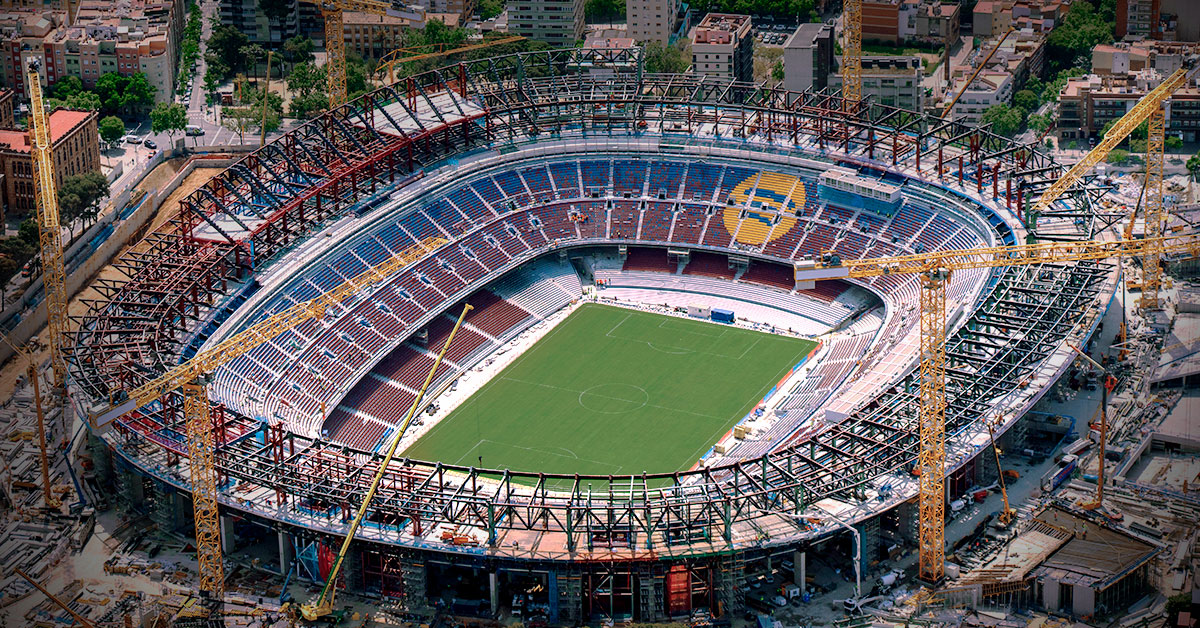
Europe is about to pour concrete. This month, Italy activated a national fund that can guarantee up to 80% of a stadium loan. The UK is halfway through a £400 million program for grassroots facilities. Private credit funds now lend against stadiums on 30-year terms. FC Barcelona shows the model at scale: its Spotify Camp Nou rebuild was funded with €1.45 billion from 20 investors, arranged with Goldman Sachs, backed by the venue’s future revenues rather than a mortgage, and restructured in 2025 to be repaid between 2033 and 2050.
Put those three together and you have the conditions for a European venue building boom. Italy alone has 14 stadium dossiers on UEFA’s desk for Euro 2032, and work must start by 2027.
Our view at N3XT Sports: the money is the easy part. A stadium is a 30-year business that happens to have a pitch in it. Cheaper capital will get more venues built. It will not make them pay. The projects that win will be the ones that design the revenue model, the fan relationship and the data into the building from the first drawing, before the structure is fixed and the contracts are signed.
What has been announced
Four pools of capital are opening at the same time, each aimed at a different part of the venue market.
Italy’s new Fondo Italiano per lo Sport offers guarantees, loans, equity and grants to clubs, municipalities and public-private partnerships building stadiums and arenas. The UK’s Multi-Sport Grassroots Facilities Programme gives capital grants for community pitches, floodlights and changing rooms. And institutional private credit from firms such as PGIM, Apollo, Ares and Sixth Street is lending long-dated money against the stadiums of top-tier clubs, in single deals from £350 million to more than €1 billion. Leagues are also starting to organize venue capital themselves, led by the NBA’s new arenas initiative for Europe.
Italy is building a state lender of last resort for sport. The Fondo Italiano per lo Sport was created by decree-law in 2025. Its implementing decree, signed by Sport Minister Andrea Abodi with the Ministry of Economy, now puts it into operation. The Istituto per il Credito Sportivo e Culturale (ICSC) runs it as a revolving fund with four sections: guarantees, loans, equity and grants. It replaces Italy’s earlier special funds, and is written explicitly for public-private partnerships. Federations, public bodies and even international organizations can pay into it.
The need is not in doubt. According to Fortune Italia, Europe built more than 150 stadiums in the last decade, only three of them in Italy, and the average Italian venue is over 60 years old. Across the 16 stadiums first put forward for Euro 2032, StadiumDB estimates redevelopment and new builds could cost up to €5.8 billion.
The UK is funding the base of the pyramid. The government’s £400 million commitment runs from 2025 to 2030. In 2025/26 it funded 991 projects, with at least half of the money going to the 30% most deprived communities. The 2026/27 round adds £85 million, plus at least £15 million for new delivery models in England, including covered courts for tennis and padel. A £5 million basketball facilities fund is matched by the NBA.
Private credit has made stadiums an asset class. Everton’s new stadium was refinanced with a £350 million, 30-year private placement secured on the stadium itself. Sixth Street and Legends paid Real Madrid €360 million for a 20-year share of new revenues at the Bernabéu. PGIM has financed the special-purpose vehicle behind Sporting CP’s Estádio José Alvalade. Lenders are looking for places to deploy. Stadiums with contracted income are on their list.
Leagues are now raising venue capital themselves. On November 25, the NBA announced plans for an initiative targeting at least €10 billion to develop and renovate basketball arenas across Europe, and the sports and entertainment districts around them. Apollo, Ares, Blackstone, KKR’s Arctos, HPS, J.P. Morgan, Sixth Street and Stonepeak are among the investors involved. The money is meant to support the new league the NBA and FIBA plan to launch in Europe in 2027, and depending on the city, the projects could include housing, offices, restaurants and public space. The NBA is not just funding arenas. It is funding year-round destinations.
Why this could become a boom
Three forces now point the same way: a hard deadline, a visible revenue gap and cheaper risk.
The deadline. Italy submitted 14 stadium dossiers across 13 cities to UEFA on October 1. Only five will host Euro 2032, and venues must be ready a year before the tournament. UEFA has been blunt about Italy’s stock, and it expects works to be underway in 2027. Deadlines move capital faster than strategy papers do.
The revenue gap. The Fortune Italia analysis, drawing on Deloitte’s Football Money League, shows the size of the prize. Real Madrid earned close to €250 million from the rebuilt Bernabéu in one season, up 103%. San Siro contributed €87 million to AC Milan. Stadium income is about 15% of revenue at Milan, Inter and Juventus, against a European average of 18%. Every club owner in Europe has seen those numbers.
Cheaper risk. A state guarantee on 80% of a loan changes what a bank will lend and at what price. Grants for interest and capital reduce the equity a club must find. Private credit fills the gap above that. For the first time in a generation, the capital stack for a mid-sized European venue can be assembled.
The risk: funding the building, not the business
None of these funds underwrites the thing that decides whether a venue succeeds: how it makes money every week for 30 years. They finance construction. The operating model is left to the owner.
That is where projects fail. We see three recurring mistakes.
Budgets set before the program. Headline costs are often fixed for political or financing reasons before anyone has defined the event mix, the premium inventory or the technology the building needs. Retractable roofs and movable pitches are sold as event engines. They are also among the most complex and overrun-prone elements in any stadium. When the real cost arrives, the revenue features are the first to be value-engineered out, and the business case goes with them.
Event revenue that depends on things the owner does not control. The Bernabéu is the reference case. Real Madrid has spent more than €1.5 billion to turn it into a year-round venue, with a retractable pitch built for concerts. After residents complained, all 16 concerts in its first six months were reported to have exceeded the 58-decibel limit, and gigs were suspended from September 2024. The club won its court case in May 2026, but the lost calendar also put pressure on its revenue-share deal with Sixth Street. Hardware does not guarantee bookings. Licenses, neighbors, acoustics and operations do.
Facilities that are built, then barely used. Italy already has more than 80,000 sports facilities, and according to the ICSC over 3,000 are out of use. Grassroots programs measure pitches built and goalposts replaced. Few measure hours booked, players retained or revenue generated after the ribbon is cut. A capital grant with no operating plan creates the next generation of empty venues.
The common thread is sequence. The money arrives before the business case is ready, and the decisions that shape revenue for three decades get made by whoever is in the room first: the architect, the contractor, the operator or the lender. Each has a legitimate interest. None of them is the owner’s.
What a bankable venue looks like
A bankable venue is one where the revenue case, the building and the contracts were designed together. That means evidence before architecture, program before price, operators before design, technology and fan data in the first drawing, and a plan to run the venue every day of the year. We set out that playbook step by step in Part 3 of this series, Document.
None of this is exotic. It is simply done in the wrong order on most projects, because the money and the deadline arrive before the business case. The new funds make that mistake more likely, not less, unless owners deliberately reverse the order.
What it means for each part of the ecosystem
Clubs and venue owners. The cost of capital is about to fall for projects that qualify. Qualifying is the hard part. Lenders and public funds will ask for a validated program, an independent cost estimate and a revenue model that survives a bad season. Build that file before you approach them, not while you negotiate. Everton did exactly that: its new stadium was refinanced with a £350 million, 30-year private placement secured on the stadium itself.
Municipalities and public funders. The Italian fund scores applications on ESG and social impact, not just financial strength. That is the right instinct. Ask every applicant how the venue will be used on the 300 days without a match, who will run it, and how usage will be reported. Attach conditions to the money. Italy shows why: the ICSC counts more than 3,000 public sports facilities out of use.
Federations and grassroots operators. The UK program rewards projects in deprived areas and multi-sport use. The next step is proving outcomes. Federations that can show bookings, participation and retention by site will win the following funding rounds. Those that can only show completed builds will compete on price. The Football Foundation already points the way, targeting government money through local plans that show where need is greatest.
Investors and lenders. Stadium debt looks like infrastructure, but its cash flows depend on event calendars, licenses and fan demand. Underwrite the operating plan and the data rights as carefully as the collateral. The Bernabéu shows how fast a revenue-share model can stall when the calendar does.
Operators and promoters. Owners will increasingly ask for data access and ownership clauses, vendor-neutral technology and transparent revenue sharing. Operators that offer those terms upfront will be easier to choose.
Our view
Europe’s venue funds are good news. Italy has finally built a financing tool that matches the scale of its problem. The UK is investing where participation starts. Private capital is ready to back stadiums that can show their numbers.
But a funding wave rewards speed, and speed is the enemy of a good venue. The decisions that matter most (program, cost, technology, data rights, operator terms) are made in the first six months, and they are the hardest to reverse.
The owners who win this cycle will use the new money to build a business, not just a building. They will know their fans before the doors open, own that relationship in every contract, and be able to show a lender, a minister or a community how the venue earns its keep on a Tuesday in February. Everyone else will have a beautiful stadium and a refinancing problem.