


Beyond the Finish Line: What Copenhagen Told Us About the Future of Road Running
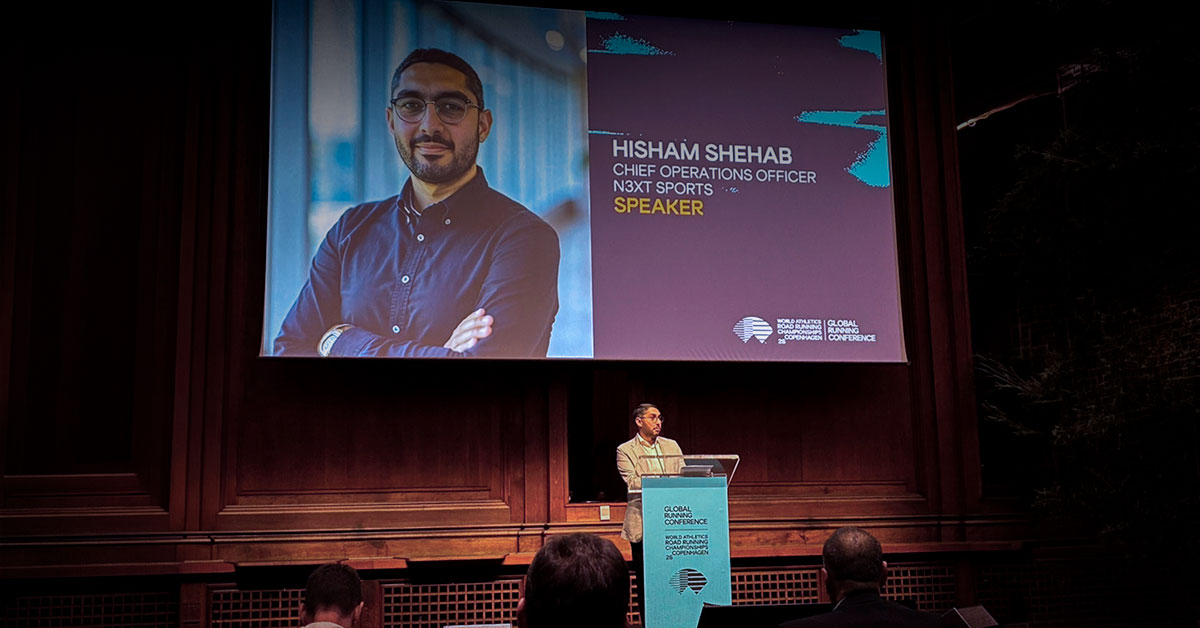
Last week, our COO, Hisham Shehabi, was in Copenhagen as a keynote speaker at the Global Running Conference, at the invitation of World Athletics. The conference ran alongside the World Athletics Road Running Championships Copenhagen 26. About 250 delegates came together over a few days: race organizers, federations, tourism bodies, technology providers and investors.
Hisham delivered a keynote covering the work we know best: building the data layer, putting AI to work and automating operations, creating a personalized engagement and app layer, and feeding it all with content. The conversations around the keynote were just as useful. Road running is one of the fastest-growing participation sports in the world. Strava reported that running clubs on its platform grew 3.5x in 2025. The industry is starting to realize its value doesn’t have to end when the last runner crosses the line.
Here’s what we brought home, and what we think it means for the sector.
Why Running Matters More in the Age of AI
One idea came up again and again in Copenhagen: as life becomes more digital, running’s core purpose becomes more valuable. Races bring people together around a goal, a community and a sense of achievement.
That matters because more people are missing it. The World Health Organization estimates that 1 in 6 people worldwide are affected by loneliness. In Copenhagen, more than half of all households are made up of a single adult, according to Statistics Denmark. Many people work remotely, and the traditional pillars of community (religion, large extended families, the local high street) no longer play the role they once did. A race gives people a reason to train with others, show up together and celebrate together. Strava’s data shows the same pattern: Gen Z is 75% more likely than Gen X to say their main motivation for exercise is a race or event.
The demand is there. The question for the industry is whether it has the tools to turn that demand into a lasting relationship, and today most races don’t.
Three Business Signals from Copenhagen
1. The Halo Effect Can Last a Week, and a Season
A marathon has a strong “halo effect”. For one weekend, a city fills up, hotels sell out, restaurants are busy and the local economy gets a visible boost. A Nielsen Sports study found the 2024 BMW Berlin Marathon generated more than €469 million in economic output within four days. Then it’s over, and the relationship with tens of thousands of participants mostly goes quiet until next year’s registration opens.
Technology can change that. With the right data and engagement layer, a race weekend can become a week-long experience: shakeout runs, expos, recovery sessions, cultural programming and partner activations, all personalized to each participant. This was one of the conference’s headline takeaways: organizers should use AI personalization year-round and position their events as weeklong destinations. Beyond the event itself, the same tools can support a full season of engagement, with training plans, community challenges, content and qualifying pathways that keep runners connected to the brand all year.
This is where the opportunity lies. The race is the peak moment, but the value is in everything around it.
2. Capital Is Following the Data Stack, and So Should Tourism
Tourism boards and economic ministries are paying more attention to running. Many now want to extend races into multi-day events to increase the number of days international visitors stay and how much they spend. For a destination, a runner who arrives on Wednesday instead of Saturday, and brings family along, is worth far more.
To deliver on that, race organizers need to know who their participants are, where they come from, how they travel, what they spend and what brings them back. Most don’t have that data today, or they have it spread across registration platforms, timing providers, spreadsheets and sponsor systems that don’t connect.
Investors see this gap. Capital is moving toward IP, technology and ventures that understand this value proposition and can execute on it. Earlier this month, a consortium led by L Catterton backed Hyrox’s founders in a deal valued at close to $700 million. It’s a clear sign of how investors now value community-driven participation formats. For organizers, the message is clear: a race with a strong data stack is no longer just an event. It becomes a measurable asset and an accelerator for local economic goals, and it has a much stronger case when talking to cities, ministries and partners.
3. Running Is Losing the Wellness Story It Should Own
Wellness and longevity are among the biggest consumer trends of the decade. UBS expects the longevity industry, which covers health tech, biotech, wellness and financial planning, to reach global annual sales of $8 trillion by 2030, and calls it one of the most powerful investment themes of the next decade. Few activities support this as well as running. It is accessible, backed by science and social by nature. A meta-analysis of more than 230,000 people in the British Journal of Sports Medicine found tha any amount of running was associated with a 27% lower risk of death from all causes.
Yet road running events rarely communicate these benefits at scale. The story is often left to individual runners, doctors or apps, not to the races and the organizations behind them.
Other disciplines have noticed. Hyrox, the fitness racing format, has grown from 3,000 participants in 2019 to 1.4 million in the 2025/26 season, and has announced plans for up to 2 million athletes across 107 races in its 2026/27 season. It has built a strong brand around fitness, community and measurable progress, which is much of the same ground running occupies. That market share was available to road running, and running didn’t claim it.
The lesson isn’t to copy Hyrox. It’s that running needs to tell its own health and longevity story with the same confidence, backed by data it already collects (training volume, finishing times, year-on-year progress) and shared through personalized, ongoing engagement.
The Aggregator Opportunity: Tech, AI and Brands
The biggest challenge we heard about in Copenhagen is fragmentation. Road running is growing worldwide, but it’s made up of thousands of independent races with their own organizers, systems, sponsors and audiences. Few of them have the scale to invest in serious technology alone.
There are exceptions. World Athletics, has built a standard framework for more than 300 races worldwide through its Label Road Races system. The system has grown from 49 races in 2008 to 303 in 2024, and it is one of the few real aggregators of value in the ecosystem today. A new group of startups, including Roster Athletics, Tigertech, CYKOM.app and r-evo, is also building scalable models to connect data and experiences across events.
We believe the next wave of aggregation will come from technology, AI and brands rather than from event ownership alone:
Technology as the shared layer. A common data and engagement platform that many races can plug into lets smaller organizers benefit from capabilities only the largest events could afford. Each race keeps its identity while the platform builds a connected view of the runner across events, cities and seasons.
AI as the multiplier. Once the data is connected, AI can personalize communications, suggest the next race, create training and wellness content, forecast demand for tourism partners and automate much of the operational work that uses up organizers’ time.
Brands as the connector. Runners don’t only follow individual races. They follow the brands, communities and goals that link them. A brand that connects many events through a series, a challenge, a wellness promise or a loyalty programme can hold the relationship with the runner year-round and share that value back with every event involved.
Whoever combines all three will be in the best position to capture the value that is currently lost between races.
Where We Go From Here
For N3XT Sports, Copenhagen confirmed that road running is a sector where our work applies directly: the data layer, operational AI, the personalized engagement layer and the content that powers it. The sector has the demand and the purpose. What it needs now is the infrastructure.
We’ll be exploring this space further, with a focus on the Middle East and Europe, where most of our business is today. Both regions have ambitious tourism agendas, fast-growing running