


Inside WFS Madrid 2026: The Business Signals Behind Football’s Biggest Week
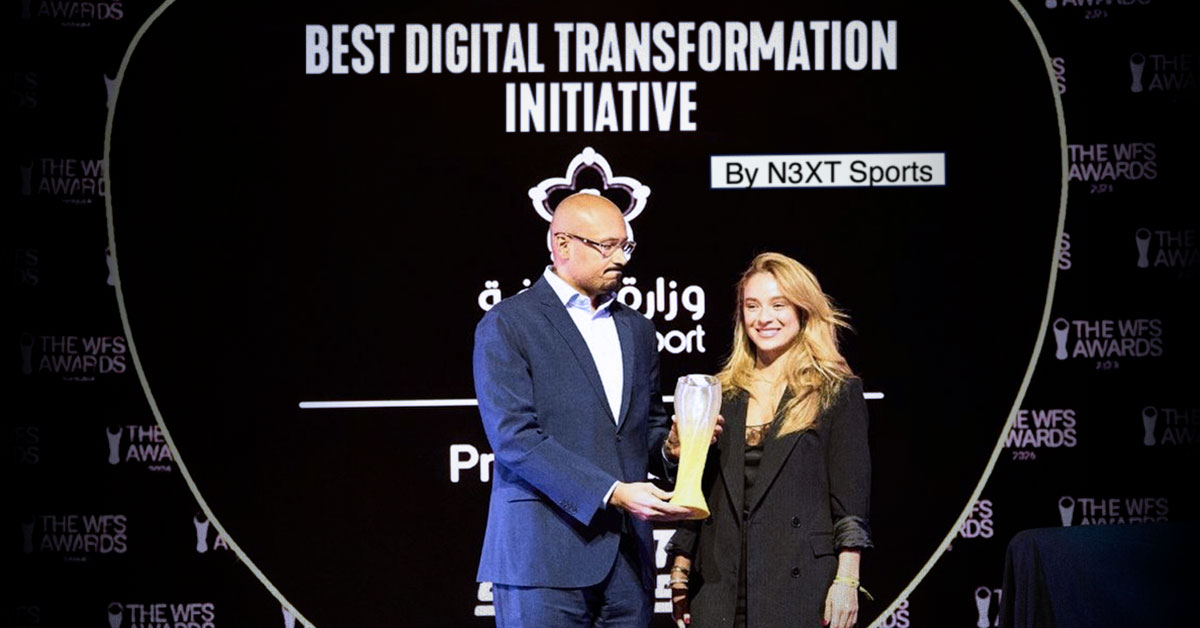
This week, La Nave in Madrid hosted the 10th anniversary edition of the World Football Summit (WFS), the largest in the event’s history: over 2,500 attendees from more than 80 countries, 130-plus speakers, and LaLiga and J.P. Morgan as headline partners. N3XT Sports was on the ground for both days of panels, and on stage for one specific moment: handing the WFS Award for Best Digital Transformation Initiative to Saudi Arabia’s Ministry of Sport.
Beyond that moment on stage, WFS Madrid offered a useful read on where the football industry’s money and attention are actually moving. Two threads from the floor stood out.
A Decade, and Then Some
WFS launched in Madrid in 2016. Ten years and 32 events later, the platform has convened roughly 42,000 attendees from more than 120 countries and over 1,500 speakers worldwide, according to organizers. This year’s Madrid edition alone drew a broader industry cross section than any prior one: club executives, league presidents, sovereign investors, and Formula 1, which joined as WFS’s first ever “guest sport,” with F1’s Liam Parker, Aston Martin ambassador Pedro de la Rosa, and Drive to Survive producer Tom Rogers discussing how a single entity racing series scaled its global fanbase.
Our Award Goes to Saudi Arabia
For several editions now, N3XT Sports has presented the WFS Award for Best Digital Transformation Initiative, a category judged by an independent panel of industry figures and awarded to football organizations using technology and data to strategically improve operations, fan engagement, or commercial performance. This year’s finalists spanned very different starting points: EasyCoach’s connected football ecosystem, Vitória SC’s fan-engagement platform, and the Saudi Ministry of Sport’s national sports platform overhaul.
The winner, announced on stage September 15: “Revolutionising the Saudi Sports and Football Ecosystem,” submitted by the Ministry of Sport.
The result is a useful data point on its own terms. A national ministry beating out two private-sector platforms for a technology award is a signal of how far public sports institutions have moved from administrative back offices toward genuine digital operators, a shift now underway across the Gulf and increasingly benchmarked well beyond it.
Two Business Signals from the Floor
1. Women’s Football Is Becoming a Genuine Capital Story
The clearest evidence came at the WFS Awards ceremony itself. Michele Kang, founder of the multi club platform Kynisca and Chairwoman and President of Olympique Lyonnais, became the first woman in the award’s ten year history to win Best Executive. The jury pointed to her transformative record across both the men’s and women’s game in Europe and North America: building the Kynisca ownership model across Washington Spirit, OL Lyonnes and London City Lionesses, then acquiring a controlling stake of close to 88 percent in Eagle Football Group, the parent company of Olympique Lyonnais.
The same ceremony recognized two more data points in the same direction. CPKC Stadium, home of the NWSL’s Kansas City Current, won Best Stadium Experience as the first stadium in the world purpose built for a women’s professional sports team. PLAYBACK, presented by Deloitte, won Best Growth Strategy. Taken together, these wins describe a vertical that has moved past advocacy and into capital allocation: dedicated ownership platforms, dedicated infrastructure, and growth metrics now measured on the same terms as the men’s game.
2. Capital Is Rewriting Who Owns the Game
A recurring thread across more than 40 sessions in Madrid was the continued financial transformation of football ownership: the accelerating entry of private capital and sovereign and investment funds into clubs, leagues and adjacent infrastructure. One notable expression of this shift: Thibaut Courtois, the two-time Champions League winner turned investor, discussed NXTPLAY Capital, the sports investment platform he co-founded to position athletes as shareholders in the assets and startups around the game, rather than simply paid ambassadors of them.
That reframing of athletes, and increasingly institutions, as capital allocators rather than passive stakeholders is consistent with a broader pattern across the industry. Organizations that treat data and digital infrastructure as strategic assets are the same ones proving attractive to this new class of capital. Digital maturity and investability are converging.
Congratulations, WFS
Ten years ago, World Football Summit started as a single event in Madrid. This week it closed its biggest edition yet, and did so while giving real stage time to the issues that will define the next decade of the business. Capital structure, women’s football as a commercial vertical in its own right, and digital transformation as a board level priority rather than an IT line item.
Congratulations to Marian Otamendi, Jan Alessie and the entire WFS team on ten years of building the platform that the global football industry now treats as unmissable. N3XT Sports has been proud to present the Best Digital Transformation Initiative award across multiple editions, and we’re already looking ahead to WFS Riyadh in January 2027, where we’ll continue that partnership on home turf for our MENA team.