


Cape Verde Lost In The Round Of 32. Its Followers Didn’t Get The Memo.
Ten World Cup teams are watching their social numbers cool off after elimination. Two are still climbing. And the data suggests the difference isn’t just about posting more, it’s about whether that content still speaks to the fans a team picked up along the way.
Elimination used to come with a predictable digital hangover. A team went out, the highlight reels stopped, and the follower count quietly leveled off until the next cycle. New tracking from the N3XT Sports Digital Maturity Index (DMI) shows that pattern is breaking in half. Twelve teams have now been eliminated from the 2026 World Cup long enough to show a clear trend, and ten of them are following the old script while two are rewriting it entirely.
One of the two outliers, Cape Verde, is out of the tournament completely. It’s still gaining followers by the hundreds of thousands, days after its last match. Here’s what the numbers say about who wins the internet after they’ve lost the game.
The Baseline: Ten Teams, One Predictable Curve
The Netherlands have posted a follower decline every single day since their June 29 penalty-shootout exit to Morocco, a third straight World Cup ended on spot kicks for the Dutch. The trend is still running as of this week.
Germany, eliminated the same day on penalties against Paraguay, is on an identical path. So are Turkey and Uruguay, both knocked out in the group stage. Add South Korea, Portugal, Saudi Arabia, Iraq, Uzbekistan and Iran, and that’s ten teams now on the same downward slope.
Portugal is the case worth watching closest. Cristiano Ronaldo’s likely final World Cup appearance ended in a July 6 loss to Spain. Even one of the most-followed athletes on the planet hasn’t been enough to hold the curve flat, which tells you something important: star power buys attention, but it doesn’t replace a content calendar.
For anyone running a national team’s digital channels, the lesson is more specific than “keep posting.” A large share of the followers a team gains during a deep tournament run showed up for the drama and the storyline, not for its usual content mix. The follower count on elimination day is a ceiling, not a floor, and holding onto it depends on giving those newer fans something as relevant as what brought them in the first place.
The Wildcard: A Controversy That Broke The Model
Belgium eliminated co-host USA 4-1 in the Round of 16 on July 6. But the scoreline barely mattered to the conversation. Folarin Balogun’s red card was suspended after a reported call from President Trump to FIFA, and Belgium’s own account needled the result minutes after full time.
That combination pushed USMNT into political and sports-media crossover coverage most eliminated teams never see. A clean follower number hasn’t landed yet, and that’s the story worth flagging: controversy-driven exits don’t behave like normal ones. Engagement spikes around the noise even as it complicates the read on where the underlying fanbase settles, so this one will likely take longer to resolve in the data than a standard elimination. One number is already locked in: according to Fox, the most-watched football match in U.S. history.
The Bull Case: Morocco Crosses A Sponsorship Threshold
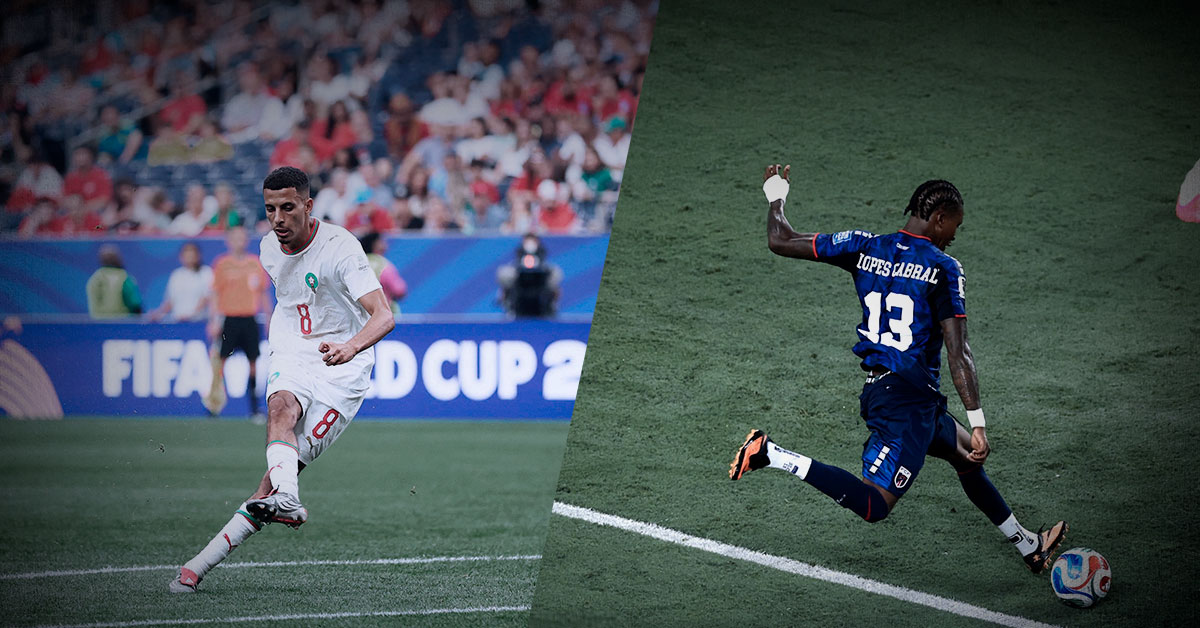
While ten teams cool off, Morocco is compounding. The Atlas Lions just crossed 10 million total followers, and their DMI score jumped 2.2 points, moving them up one spot to #29 globally.
Ten million is not a vanity number. It’s roughly the point where a brand’s media-buying team stops treating a partnership as goodwill and starts pricing it as reach. A separate cross-platform audit of all 48 World Cup squads by Shikenso puts Morocco’s combined following at 12.2 million, the only African team in the tournament’s top 10, ahead of several European sides with far longer World Cup pedigrees.
The results back it up: Morocco beat co-host Canada 3-0 on July 4 to reach the quarterfinals for the second straight World Cup, extending a run built on 19 games unbeaten since 2025.
The Anomaly: Cape Verde Proves Elimination Isn’t The Ceiling
Cape Verde was eliminated in the Round of 32 on July 3, falling 3-2 to Argentina in extra time. Its followers didn’t slow down. They sped up.
The numbers: a 22% day-over-day follower jump on July 4, the day after elimination. Then 35.1% on July 5. 13.5% on July 6. 2.4% on July 7. 1.4% on July 8. Five straight days of growth after the team went home, stacked on top of the surge it had already built by beating Uruguay and drawing Spain in the group stage.
The individual-level numbers are just as striking. Goalkeeper Vozinha entered the tournament with roughly 46,000 Instagram followers and left it with more than 22 million, a 40-year-old second-division goalkeeper briefly out-followed by nobody except the world’s biggest athletes, and ahead of stars like Shohei Ohtani and Luka Dončić.
The takeaway for brands and sponsors: a compelling underdog story has a longer shelf life than the tournament bracket. The team stopped playing. The story didn’t.
The Multiplier Effect: Beating A Giant Pays Twice
Norway eliminated five-time champion Brazil 2-1 in the Round of 16 on July 5, handing Brazil its earliest World Cup exit since 1990. Two days later, Norway’s follower count jumped roughly 21% day over day. The day after that, it added another 5.2%.
That’s the digital signature of beating a giant: it isn’t just a result, it’s a distribution event. Erling Haaland’s personal account shows the same pattern at a larger scale, with more than 6 million new Instagram followers in the two weeks before the Brazil match, crossing 46 million by July 2, according to Tribuna. His post-match selfie picked up 1 million likes in 12 minutes.
The Lag: Why Brazil’s Numbers Haven’t Moved Yet
Brazil’s expected post-elimination shift hasn’t shown up in the data. Neither has Argentina’s or Egypt’s, despite both facing knockout losses in the same window. That’s not a gap in the model. It’s a pattern the DMI has picked up in tournament after tournament.
Global giants simply move slower. A brand the size of Brazil carries millions of passive followers who signed up years ago and rarely engage either way, which means a single loss doesn’t register overnight. Expect that number to start shifting over the next several days, not hours.
The Bigger Picture
The World Cup has quietly become a live, 48-team test of which digital assets compound and which ones plateau the moment the football stops. So far, the pattern holds: teams that keep publishing content that speaks to the fans they picked up during the run, and not just their usual match-day material, hang onto more of that audience. Teams whose post-tournament content doesn’t carry the same relevance for those newer followers, or that stops publishing altogether, tend to see the numbers settle lower, the way the current curves for the Netherlands, Germany, Turkey and Uruguay suggest.
The teams best positioned over the next four years won’t necessarily be the ones that walked into the June 11 kickoff with the largest starting audience. On this data, they’ll look more like Cape Verde and Morocco, teams that treated the final whistle as the start of a new chapter, not the end of one.
The quarterfinals begin July 9. If the pattern holds, expect at least one more Cape Verde-style breakout from a team with no business still trending, and a real chance for this round’s eliminated sides to prove just how fast a strong tournament can convert into lasting digital equity.
The full team-by-team rankings, scores, and follower trajectories behind this analysis are tracked in real time on the N3XT Sports Digital Maturity Index.