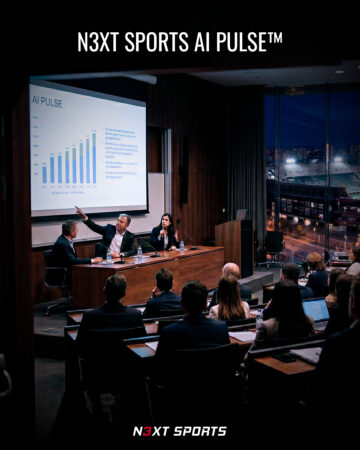



Collaboration, innovation and open exchange were at the heart of the recent ASOIF Sport Development & Education Workshop in Lausanne, where International Federations examined how artificial intelligence and new technologies will shape the future of sport development and officiating. Organised by the ASOIF Sport Development and Education Commission (ASDEC), the two-day meeting brought together more than 60 representatives from over 30 International Federations for peer-to-peer discussions on coaching, officiating and participation pathways.
N3XT Sports CEO Mounir Zok was invited to deliver a keynote on how federations can move from instinct-based decision-making to unified, data-informed operations where AI acts as an operational layer rather than a standalone tool. His intervention aligned with ASOIF’s broader focus on helping federations embrace new technologies in practical and responsible ways across sport development and education.
“The organizations that thrive will be those that stop treating data as a by-product of their operations and start treating it as the connective tissue that links sustainability, fan engagement, operational efficiency and commercial growth,” said Mounir Zok, CEO of N3XT Sports.
A central theme of the keynote was that the sports sector has reached a point where data maturity is no longer a back-office issue; it is now a strategic requirement for federations that want to modernise, scale impact and make better decisions. For many governing bodies, the challenge is not a lack of ambition but the persistence of disconnected systems, fragmented reporting and uneven levels of digital literacy across teams.
ASDEC, chaired by Deqa Niamkey, Development Director at United World Wrestling, plays an important role in convening International Federations around shared development and education challenges. That context made the Lausanne workshop especially relevant, because discussions on AI and officiating were not treated as isolated technology topics, but as part of a broader conversation about how sport can remain credible, inclusive and fit for the future.
“What stood out in this workshop was how open federations were about both the opportunities and the barriers they are facing,” said Deqa Niamkey. “There is a real appetite to use AI and data more intelligently, but also a clear understanding that progress depends on governance, trust and making sure these tools genuinely serve coaches, officials and participants.”
For N3XT Sports, that challenge sits at the core of its advisory work with sports organisations navigating digital transformation. Rather than treating AI as a trend or a collection of tools, the company’s perspective is that federations need to understand how data, workflows, leadership alignment and organisational capability all connect. In practice, this means helping organisations shift from experimentation at the margins to embedded ways of working that improve decision-making across the business.
One of the strongest messages from the keynote was that AI only creates lasting value when it is built on top of reliable data foundations. Many federations still manage participation, education and operational information through siloed spreadsheets, local databases or disconnected reporting structures, which makes it difficult to see the full picture of how their ecosystem is performing. In that environment, even the most promising AI applications risk becoming superficial because the underlying information is incomplete, delayed or inconsistent.
This matters especially for sport development leaders, who are increasingly expected to show not just activity, but impact. Counting courses delivered, grants distributed or officials trained is no longer enough on its own; leadership teams and external stakeholders want stronger evidence of what programmes are changing, where bottlenecks exist and how resources should be allocated. A more connected data environment allows federations to move beyond static reporting and toward insight that can shape investment, programme design and performance measurement.
The Lausanne discussions also reinforced that AI should be understood as a cross-functional enabler, not simply as a single software purchase. When deployed effectively, it can support labor-intensive workflows such as grant administration, meeting synthesis, first-draft content generation, federation onboarding and knowledge management, allowing lean teams to operate with greater consistency and speed. In that sense, AI becomes less about novelty and more about strengthening organisational capacity.
“AI is not a tool that people use occasionally,” Zok said during the session. “It is an operational layer that should continuously support how the organisation is run.”
The officiating dimension gave the workshop an especially timely edge. As federations explore how technology can improve accuracy, consistency and learning, the conversation is expanding beyond elite competition into broader questions of development, education and trust in sporting systems. Used responsibly, AI can help officiating departments analyse patterns, identify areas for improvement and support education pathways for technical officials, while preserving the importance of human judgement and contextual decision-making.
That balance between innovation and responsibility was also reflected throughout discussions at the ASOIF Sport Development & Education Workshop. Conversations in Lausanne explored both the opportunities and practical challenges associated with the use of AI and emerging technologies across coaching, officiating and sport development. Participants highlighted that meaningful adoption depends not only on technology itself, but also on governance, organisational readiness, digital literacy and clarity of purpose.
For N3XT Sports, this is where thought leadership must connect with implementation. The company’s role is not only to identify trends, but to help sports organisations understand what those trends mean in operational terms: how to structure data, how to build internal literacy, how to define governance and how to integrate AI into workflows in ways that create measurable value. That position resonated strongly in Lausanne because it addressed a reality many federations now face: pressure to modernise without adding significant headcount or complexity.
The workshop also highlighted a broader shift in the international sports movement. AI is no longer being discussed only as a future issue or as an experimental add-on for innovation teams; it is increasingly being treated as part of the core infrastructure that will shape how federations educate, govern, support officials and serve participants in the years ahead. Organisations that build the right foundations now will be better positioned to respond with speed, confidence and coherence as expectations continue to rise.
For that reason, the value of forums such as the ASOIF Sport Development & Education Workshop extends beyond the event itself. They provide International Federations with an opportunity to exchange experiences, compare approaches and discuss shared challenges related to sport development, officiating and emerging technologies. N3XT Sports contributed to the Lausanne discussions as one of several external perspectives invited to support dialogue around AI, data and organisational readiness within the international sports sector.
As International Federations continue to explore the implications of AI for development, coaching and officiating, the next step is clear: turn discussion into execution. That means strengthening data governance, raising digital literacy, designing practical use cases and creating operating models where technology supports people rather than overwhelms them. The federations that succeed will not necessarily be those with the most tools, but those with the clearest strategy for connecting data, people and purpose.