


By Mounir Zok
Organizations that master data governance and multi-stakeholder collaboration will define how sport is run, watched, and monetized in the decade ahead – while 2026 will be remembered as the year sport becomes truly data-native.
It was not long ago that data was seen as a blunt, back-office tool in sports governance, while most strategic decisions were still made on instinct. Even as late as the 2010s, many clubs, leagues, and federations relied on siloed systems and incomplete information, only accelerating their digital shift during the Covid-19 pandemic as “digital-first” became a survival strategy rather than a choice.
For two decades, sport treated data as a side project; the next decade will treat it as the operating system.
Data analysis for high-performance strategy and coaching has been an expanding force throughout the past half-century. From early baseball analytics in the 1960s to Moneyball’s mainstream breakthrough and today’s AI-enhanced wearables, elite sport has already embraced data as a competitive asset. Now, however, the real disruption is happening off the field.
On the other side of the whitewash, the front offices of major sports properties are upgrading their fan and operational data infrastructure to drive commercial growth and resilience. By way of example, Major League Baseball (MLB) and the National Basketball Association (NBA) are among those delivering centralized, data-led strategies. Outside major-league sports, however, many properties are still only “dipping their toes”, relying on fragmented user experiences (UX) and information, rather than one universal ecosystem.
According to an industry study, as recently as 2021, 61 percent of sports organizations claimed not to use data for strategic planning, whereas 51 percent of sports organizations were said to centralize their data collection. Furthermore, the research shows that as many as 25 percent did not collect fan data, and only 10 percent of properties communicated their data objectives across the entire organization, meaning that useful information was only being made available to senior executives. In other words, a clear majority of the industry was still flying blind while a smaller minority quietly built the foundations of tomorrow’s competitive advantage.
This is now changing. And at a rapid pace. N3XT Sports research highlights that sports properties are not only embracing data and digital transformation; they are also diversifying their workforce to meet new demands among their fans and stakeholders by integrating specialist digital and data personnel across departments. According to our findings, in 2025, the vast majority of professional clubs and franchises in Europe’s and North America’s most popular leagues employed one or more digital product managers and data scientists. The real transformation is not in the dashboards, but in the job descriptions and the decisions they empower.
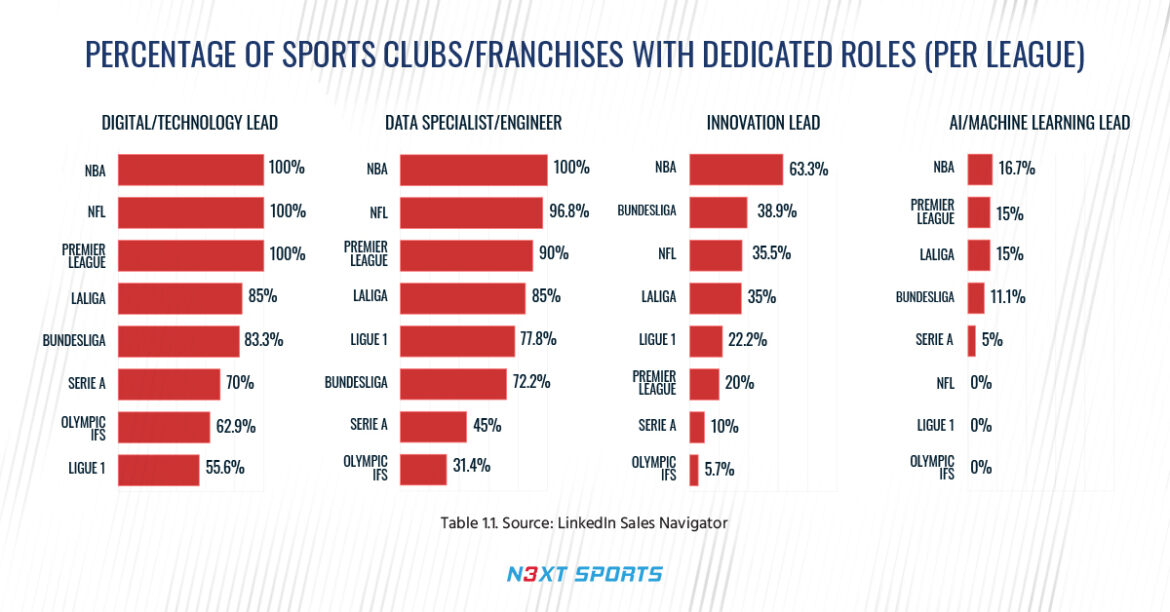 Nevertheless, as the industry evolves, there are still very few sports clubs and franchises which employ dedicated innovation leads, for example, whereas even fewer are hiring specialists in AI, despite the industry being set to invest US$9.7 billion in AI and machine learning technology in 2026. As the sector moves further towards data sharing in multi-stakeholder ecosystems, data-informed strategy development, and AI-powered fan and athlete intelligence, data centralization will be key for optimizing an organization’s workforce efficiency and maximizing its return on investment (ROI), undoubtedly in ways we haven’t seen before. Hiring a data scientist without fixing your data governance is like hiring a pilot to fly a plane you haven’t built yet.

Sport Has Entered Its “Ecosystem Era”
Sports organizations now sit inside interconnected value chains. Success depends on how well these entities share data, coordinate strategy, and align incentives. Whereby centralized data systems improve operational efficiency, signalling a definitive shift towards ecosystem-led frameworks, through 2026, the most advanced sports bodies will rely on hybrid data architectures designed for scaling real-time decision-making and multi-stakeholder governance. Sports organizations that still act like linear hierarchies in an ecosystem world are already behind the curve.
This is something that our team at N3XT Sports continually reiterates within its network: sports organizations must operate as multi-stakeholder ecosystems, not linear hierarchies. This approach allows bodies to scale and diversify revenue streams and build resilient governance models which meet demands throughout an increasingly complex global sports economy. Several of our clients are already integrating their organizational structures this way. The next big divide in sport will not be between rich and poor, but between data-orchestrated and data-blind ecosystems.
By way of example, N3XT Sports has supported the design, implementation and management of the Professional Footballers’ Association’s (PFA) data and digital transformation strategic plan since 2022. This included the creation of the England and Wales footballers’ union’s fully integrated PFA Member Portal and PFA Employee Portal, as part of its vision for a multi-functional, member-centric digital ecosystem. These tools now underpin a more connected, member-centric digital ecosystem, delivering faster processing times for member applications, a smoother UX for players, and greater visibility of activity and productivity for PFA decision-makers.
Speaking on its evolution, the PFA’s Chief Operating Officer (CCO) Patrick Coyle says: “Whereas, historically, the PFA has been heavily reliant on ‘old fashioned’ paper communications […] our collaboration has transformed the way in which our organization collects, shares, and analyzes membership data – granting our members a better UX and more resources for our executives to best meet their needs.”
The PFA’s journey shows that when you modernize data, you don’t just build portals; you build a different way of listening to your members.

From Strategy to Scenario Planning, Data is Essential
Whether enhancing high-performance environments or empowering business growth through operational efficiency, data is the “fuel” for driving success inside sports entities at all levels. As organizations undergo their own data transformations, data ownership alone is not enough to deliver results. There’s a need for optimizing data-management processes to improve strategic decision-making within every department, while data alignment across multi-stakeholder ecosystems is key to executing the strategic roadmap that binds them. Owning data is not a strategy; governing it together is.
Despite this, during preparations for the Milano Cortina 2026 Winter Olympic & Paralympic Games, and as the industry builds towards the Los Angeles 2028 Summer edition (LA28), N3XT Sports research indicates that far fewer International Federations (IF) prioritize data governance (45 percent) as part of their strategic planning as they do other verticals. According to comparison analysis, the majority of IFs prioritize high-performance development (90.9 percent), organizational integrity (90.9 percent), innovation (86.4 percent), digital transformation (81.8 percent), and fan engagement (81.8 percent).
Nevertheless, other areas including education and change management (65.9 percent), commercial expansion (56.8 percent), sustainability (56.8 percent), and athlete welfare (59.1 percent) are less prominent within the sector’s strategic plans. While fewer IFs place strategic focus on data management – a core asset for driving operational efficiency, performance, and commercial growth – consistent data policy is essential for centralizing the strategic direction within multi-stakeholder ecosystems, while allowing organizations to decentralize strategy execution across stakeholders. This model is particularly powerful in sport, whereby organizations manage hundreds of stakeholders. Without shared data standards, even the best strategy becomes a collection of disconnected projects.

The Fan-Data Feedback Loop™ | AI-powered Predictive Modeling At Play
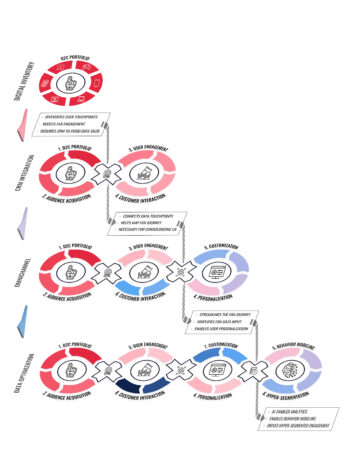
As sports organizations explore options to increase data-value, deciding how to transform their digital and technological frameworks is an important and necessary step. N3XT Sports recently launched The Fan-Data Feedback Loop™, a proprietary framework for scaling a sports organization’s fan-data infrastructure and processes. As opposed to the linear “fan funnel” commonly used throughout the sports industry, the framework illustrates the fan journey as a dynamic information loop, including three essential phases in an organization’s fan-data transformation: (1) the integration of a centralized information system for capturing and leveraging fan data; (2) the role of an omnichannel UX for personalizing the fan experience; and (3) the role of AI for identifying customer-conversion trends. The Fan-Data Feedback Loop™ replaces the old fan funnel with something more honest: a continuous conversation at scale.
Organizations that modernize their architecture, governance, and AI capability will be the most competitive in the coming decade. Those that wait will be caught in legacy systems and outdated governance, while no longer relevant in the modern age of instant, hyper-personalized fandom. LaLiga’s partnership with Microsoft is a clear example of this shift. The top-flight Spanish football league now generates 3.5 million data points per match. Using AI to deliver predictive insights for performance, fan engagement and media production, this represents an early blueprint for the “predictive league office” that will define sport through 2026 and beyond. Tomorrow’s predictive league office will know when a fan is drifting away long before the fan does.
As we look forward, AI will play a more active role in analyzing data. According to industry research, federations using predictive fan analytics experience a 15–30 percent increase in annual audience engagement and retention. While helping to improve productivity and the efficiency of an organization’s customer-data management, data centralization is a crucial step for sports properties to take while seeking to automate their processes successfully. AI is not there to replace the human touch in sport; it is there to make sure that touch is timely and relevant.
Therefore, developing the right data strategy for your organization is imperative and begins with efforts to streamline its data touchpoints; only then will AI-driven analytics systems uncover the best fan intelligence and customer insights to take your D2C strategy to the next level. In the ecosystem era, data strategy is no longer a technical project but a leadership responsibility. The organizations that treat data governance as a strategic pillar in 2026 will shape how sport is governed, experienced, and commercialized in the decade ahead.
About N3XT Sports
N3XT Sports is a specialized sports industry agency focused on strategy, operations, and end-to-end data and digital transformation. Its team has delivered hundreds of projects across Europe, the Americas, and the Middle East, spanning sports commercialization, digital product development, data strategy, investments, competition formats, and performance. With its operational HQ in Valencia, Spain, and a MENA office in Riyadh, Saudi Arabia, N3XT Sports helps rights holders, investors, and sports organizations redesign their business models for a data-native future.
N3XT Sports supports its clients at every stage of their digital transformation and strategy development. To find out more about how N3XT Sports can serve your organization and develop its very own tailor-made business strategy, fill out the form below, and we’ll be in touch. We look forward to hearing more about your journey.