


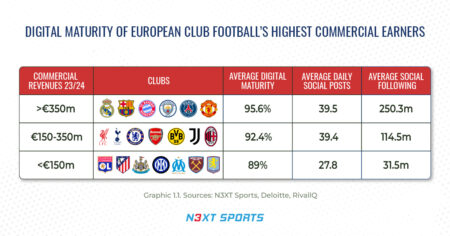
One of the sports industry’s leading markets for digital fan engagement, top-flight European football demonstrates high levels of maturity within the direct-to-consumer (D2C) space, with many clubs adopting an array of digital products. While the sector features a range of benchmarks, including a correlation between the digital maturity and commercial success of its highest earning properties, there are multiple areas which are primed for investment – notably how football clubs optimize and augment the use of data between their departments.
According to N3XT Sports research, while the digital and data maturity of European clubs highlights the growing appetite for digital fandom in European football, this isn’t indicative of their overall digital performance, with many top-flight clubs assessed showing irregularities in the types of products they invest in, whereas many are yet to optimize their digital assets and internal dataflows.
By way of example, whereas the vast majority centralize their fan-data collection via a single sign-on (SSO) and/or via a web login, and integrate some form of centralized information system to manage fan data, as many as 75 percent have yet to streamline their customer-facing platforms within an omnichannel experience (including 65 percent of Europe’s highest earning clubs), highlighting the levels of fan-journey fragmentation which exists across the club ecosystem.
This points to an opportunity for European football clubs to optimize the customer journey by consolidating the UX and maximizing their value per fan within a framework which truly puts each customer at the heart of the organization’s decision-making. While there are many clubs across European football which have consolidated the fan experience in this way, much of the sector is still in its infancy when it comes to its data management as well as its ability to optimize the fan journey.
This has been a long-standing conundrum: how football clubs leverage data to serve its off-field business development. “It’s clear from the research that the majority of elite European clubs are collecting the data, but there is a case that they could be using the data more effectively and to better serve their commercial growth and processes,” explains Marcos Pelegrin, N3XT Sports’ Director of Commercial Services and former LaLiga Strategic Projects Director – MENA.
“There’s a traditional mindset in football,” he goes on. “It varies across markets of course – however, oftentimes a lot of the resources available in the club game are allocated to teams, players, and their performance on the pitch.” Marcos adds that other areas of the business “usually comes second, third, or even last” when it comes to financial investment and, while player development is flourishing in the game, to be commercially competitive, clubs “should be investing more” in their digital capabilities.
Digital transformation links on-field performance & front-office efficiency
N3XT Sports assesses European football clubs for their digital transformation efforts across four key verticals, including: (1) their digital-product investment and fan-data collection; (2) how digital transformation is shaping the stadium experience; (3) the role of data in performance analytics and how it informs other areas of the company; and (4) the strengths of each club’s customer relationship and its ability to innovate.
Using N3XT Sports’ unique research methodology, our findings shows that every club which scores more than 85 percent for their overall digital transformation efforts combine player analytics and customer relationship management (CRM) when considering a digital transformation partner. Considering that the majority of top-flight European clubs assessed incorporate some form of data-analytics technology within their elite-player ecosystems and recruitment strategies, the connection between those which combine their on- and off-field data management also reflects a correlation in each club’s commercial growth.
By comparison, 83.3 percent of clubs which earned over €350 million commercial revenues during the 2023/24 season incorporated every department within their digital transformation, whereas fewer than half (42.8 percent) of clubs which earned €150-350 million commercial revenues followed this trend. For example, the richest football club in the world, Real Madrid, is among those which re-imagined its “engagement infrastructure”, an approach which the club’s Chief Transformation Officer Michael Sutherland says was critical in creating a “connected ecosystem” and “unified digital strategy”.
“We had to better understand our audience, how to acquire further ‘users’ and ultimately, how to sell directly to them,” Michael tells Calibre One. “This required a new engagement infrastructure. I tend to view the structure of the football club through several different lenses. One of these was to look at the club as a retail brand, observing structural differences in professional sports teams vs pure consumer retail brands. Having separate sporting and commercial divisions posed several challenges, including capital allocation, with on-pitch performance often prioritised over commercial growth.
“We also worked hard to bring previously outsourced additional revenue streams (outside of sponsorship, stadium receipts and broadcast) more under the control and direction of the club, giving us the ability to directly offer more value to fans and create more seamless fan journeys across all club commercial and communication channels, ultimately allowing us to grow our first-party fan database and understand the needs of our fans better. This was hugely beneficial in our shift towards a D2C model.”
Mobile integration is helping European clubs to personalize the fan experience
Customer-behavior modeling is a key attribute within a modern sports organization at a time when fans are encouraged to tell rights holders what they want from their digital experiences. According to an IBM study, 85 percent of fans see value in technology integration for enhancing the sports experience, such as artificial intelligence-powered (AI), personalized engagement, while 73 percent say they engage with dedicated mobile sports apps.
Understanding user behavior at a granular level uncovers unique strategies for driving fan loyalty and customer conversions. Therefore, to maximize fan value, it’s crucial that sports organizations and rights holders consolidate their data collection via a centralized information system – whether that’s a CRM solution or Customer Data Platform (CDP) – and one which serves to create an omnichannel fan experience which integrates every one of their data touchpoints, while streamlining the fan journey.
As clubs continue to consolidate data to optimize their digital portfolios, several properties have gone a step further by fully integrating their entire D2C product-line within a mobile app. By utilizing an omnichannel experience, clubs are making it easier to personalize the UX and centralize the influx of large quantities of fan information and user feedback. According to N3XT Sports findings, up to 85 percent of European clubs enable fans to personalize their digital experiences, including the option to choose player and team preferences within multi-team outfits, and opt in to a selection of communications channels.
By comparison, albeit mobile ticketing, for example, is ubiquitous among Europe’s top football clubs, and the vast majority (95 percent) collect first-party fan data via their own mobile products, very few have yet to optimize their mobile features for in-stadia purchases (29.1 percent) and non-matchday stadium features (18.7 percent). This highlights an opportunity for clubs to capitalize on the mobile-fan experience by personalizing the stadium experience, too. For example, Bundesliga champions Bayern Munich own a highly connected digital and data infrastructure, including a benchmark for the stadium experience, which caters matchday and non-matchday modes within the club’s Allianz Arena mobile app.
Opportunity beckons for AI leadership
As clubs consolidate the digital UX, while enabling the fan to personalize their experience, they are also unlocking opportunities to analyze granular fan data using AI, drawing on unique fan behaviors and customer trends. As a priority, some properties are hiring their own AI specialists to boost their digital and operational performance. This is identified by European football’s hiring trends – for example, 78 percent of top-flight European football clubs with AI expertise also employ experts in digital-platform management, innovation, and data analysis, highlighting the importance clubs place on owning a well-connected digital and data ecosystem when exploring opportunities to adopt AI-powered tools.
Therefore, whereas the minority of clubs assessed hire their own AI specialists, and while disparities exist between the data-collection and CRM maturity levels of the handful that do, opportunities remain for club football to optimize its use of AI by first consolidating their fan, stakeholder, and business data. For example, clubs which offer an omnichannel experience via mobile are twice as likely to leverage AI for measuring fan behaviors compared to those which do not. Meanwhile, 60 percent of Europe’s highest-earning clubs with fully integrated data ecosystems – including athlete, fan, and business data – provide an omnichannel experience.
This demonstrates a correlation between those clubs with a high data maturity and those which consolidate their digital inventories, while also highlighting benchmarks for commercial growth across the sector via AI-powered data governance. Despite this foresight, many sports properties have yet to optimize their D2C portfolio to enhance their use of fan data and inform their commercial strategy, whereas 35 percent of the continent’s highest earning clubs invest in AI expertise, dropping below an average 15 percent of clubs across Europe’s top divisions.
—
N3XT Sports develops and implements data and digital transformation strategies within sports properties at federation level, competition level, and club level. To find out more about how N3XT Sports can serve your organization, fill out the form below, and we’ll be in touch. Our goal is to drive the digitalization of the sports industry and our clients.