


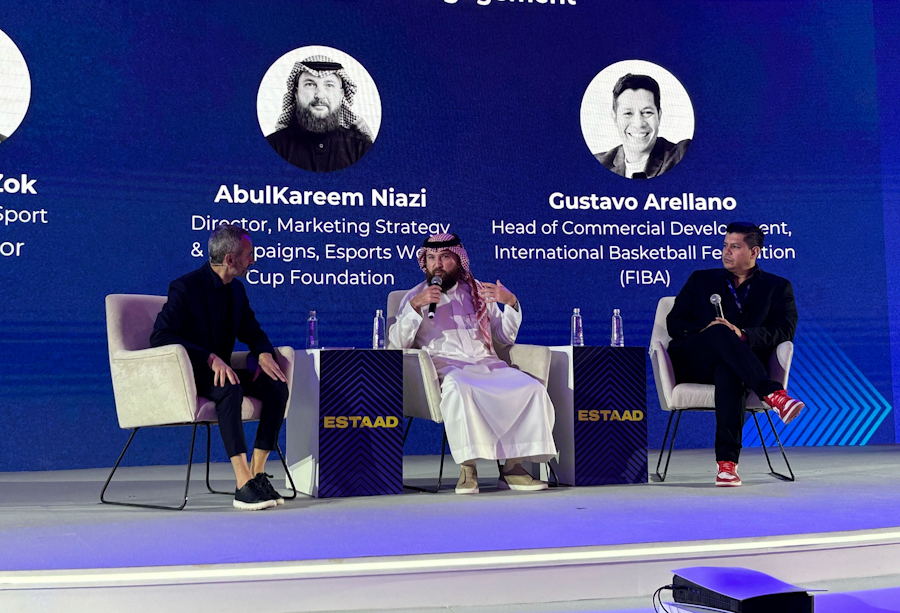
As rights holders explore unique ways to attract new fans and generate customer loyalty, how to turn the passive fan into an active, engaged consumer is perhaps the foremost challenge sports properties face in the age of direct-to-consumer (D2C) communications. Debating this topic, N3XT Sports CEO Mounir Zok moderated a panel at Cityscape Global 2025 in Riyadh, Saudi Arabia, which discussed the fan-engagement strategies being adopted by esports and “traditional” sports organizations and where commonalities lie between the two sectors.
Mounir was joined on the ESTAAD – Sports & Entertainment stage by AbdulKareem Niazi, Director of Marketing Strategy, Campaigns & PR at the Esports World Cup Foundation (EWCF), and Gustavo Arellano, Head of Commercial Development, at the International Basketball Federation (FIBA). According to both, sports and esports fans share more in common than they don’t, including a passion for competition. Considering this, there are many learnings each sector can take from the other, they say, including a universal connection between modern fans who no longer simply watch live competition – but want to become a part of the narrative, too.
For example, FIBA has for a long-time seen esports and gaming as avenues for engaging a new demographic of basketball supporters. By way of example, Gustavo says there is a generation of basketball fans who are engaging and learning about the sport exclusively through gaming. As a result, this trend has encouraged FIBA to explore avenues for the federation to meet peripheral and non-basketball fans “where they are”, Gustavo continues, in effect adding new layers to the fan journey and expanding FIBA’s audience reach.
How can esports and traditional sports convert passive audiences into active fan communities?
:: “It’s great to start without the comparison between esports and sports and focus only on what we could do for our fans,” Gustavo says. “The first understanding in the organization was that fans are getting in contact with basketball through different formats. They weren’t necessarily engaging by watching NBA games only; there is a generation of people who learned the rules of the game, the names of the players, through a video game, including a console, via mobile, and other formats.
“For us, understanding how to connect with those audiences and to go to where they are to create a space for them to [engage with basketball] was the key to understanding that these people are not only watching the sport but are connecting through the sport. So that was the first step to why we needed to make an effort to support the development of basketball by creating a community. This is important for turning a traditional viewer into not only somebody who we can communicate with but someone we can also create different experiences for.”
:: AbdulKareem concurs, stating that digitally native audiences expect hyper-personalized, interactive, and participatory experiences that make them feel involved in both the narrative and the data behind the sport. “Anyone who watches sports or esports has passion. It’s about how we spark that passion into a belonging and building that loyalty. In esports, we know fans no longer want to be reading the story – they want to be a part of it. That’s the part of connect we must continue to build on. They no longer only consume the data; they become part of the data and part of the story.
“The second part that I think is important in that ingredient is the experience. Nothing builds commitment, nothing builds those emotions, except when you visit the arenas, watch others play, becoming part of the story. For me, it’s a very simply formula: everyone has passion, connection brings them together, and such events or experiences build the community behind it.”

Community-building through technology & immersion
What role are emerging technologies playing in deepening fan engagement and ownership?
:: Emerging technologies are central to unlocking deeper fan relationships, according to AbdulKareem. “If I look at the younger fans today, what they expect is completely different from what we expected many years ago,” he continues. “I circle back to the fact: they don’t want to watch or consume; they want to partake, and they want it to be personalized, and for it to be ‘digital’. So, with everything that is around us and all the digital capabilities, it provides us with the platform to tap into different fan needs.
“For example, blockchain gives you a sense of ownership through tokens and rewards, AR and VR is immersive and brings the experience to your living room while enhancing the storytelling and enhancing engagement, and the metaverse creates that ‘always-on’ kind of world where consumers are able to be always-connected, always socialising, always engaging with the brand as a fan.”
:: Whereas research today indicates shrinking attention spans among younger fans, Gustavo outlines evidence on the contrary that fans will engage with personalized content for long periods if content is packaged well.
“We’re in a moment where our children will know more things than us about many things,” Gustavo goes on. “How to engage with our sports will evolve. We are in an era of shorter attention spans, where we have considered at many levels to adjust the rules or to make the games shorter. For example, when working with Twitch four years ago, the average time for people watching basketball on Twitch was more than two hours.
“That was a very important lesson for [FIBA] that the delivery and the way of showing those stories and moments needs to be personalized to the person you are directing them to. Now, it’s not about the game changing, but how its packaged. So, it’s not about the game changing or making highlights shorter. If packaged properly, people can be there as much as they need. At the end of the day, it’s entertainment. This has made us change how we deliver our traditional content.”
Changing commercial & brand relationships
How are new engagement models creating sustainable revenue and brand loyalty?
Brand partnerships have evolved from simple visibility to integrated storytelling as rights holders develop their D2C capabilities. As a result, commercial and sponsor involvement has broader avenues to align with sports and esports brands which align to their goals and value, while Gustavo highlights the importance for authentic narratives to generate fan loyalty within a partnership.
:: “In our case, the whole process of dealing with partners and sponsors has changed from the core,” Gustavo continues. “In the past, we were in the business of adding value and being in the position where our property could deliver whatever that brand was expecting. Now it’s about the conversation.
“Instead of delivering value, now it’s about how the conversation [with fans] in our organization can fit with that brand. That’s an evolution that we have experienced when delivering value and is not necessarily about changing the sponsorship package. If you are a brand that understands where your customer lives, what they want and like to do, you can fit into that conversation and have an advantage.”
:: AbdulKareem says, in esports, sponsors now seek interactive brand experiences where fans actively engage and “live” the brand at festivals and events, whereas the commercial partnership is also shifting towards collaboration and shared growth. “Fans no longer want to come in and see your brand there. They want to feel the experience and want to explore what the brand represents. That’s something we have done this year with our partners.
“What does this mean for the fan? It means they can interact with the brand and what the brand has to offer. With our sponsors, on the other hand, it’s now about how we both excel in what we offer. Do we fit in what each other offers? That’s why it’s a constant narrative that delivers the best value to the sponsor, our fans, and everybody that exists around our ecosystem.”
Bridging traditional sports & esports
What can traditional sports learn from esports’ pace of innovation, and vice versa?
:: According to AbdulKareem and Gustavo, there is fertile ground for collaboration between traditional sports and esports since the two sectors “have a shared DNA” when it comes to building competition and community-driven fandom. “We are both built on competition, the community we belong to, and its passion,” AbdulKareem expands. “We can learn from each other. What I’ve found interesting from an esports perspective is the speed in which things move, how development is constant. That brings a lot of eyeballs to what you do.
“We’ve been created on ‘digital’, so we started talking with our fans from the very beginning. It’s always a two-way engagement, as opposed to the traditional broadcasting. We work with a lot of content creators and influencers within the ecosystem, bridging between the fan themselves, the teams, the players, and the ecosystem as a whole. That together is what esports excels in. Obviously, traditional sports have existed for years; they have the right governance and structures, and a lot of things we are trying to learn from and lean on. We are adopting this more.”
:: Speaking to the future of the sectors, Gustavo believes “digitalization, personalization, and the ability to live experiences” will define fan engagement going forward. “How it will be consumed and the business will have changed,” he says. “We are therefore looking to go where [the fans] are. So, instead we are going to [broadcast partners] who are driving different audiences to those that we have. To do that, we need a story to tell. When we manage that, the outreach of our product begins to increase. And we’re starting to see the results of that now.”
—
N3XT Sports develops and implements data and digital transformation strategies within sports properties at federation level, competition level, and club level. To find out more about how N3XT Sports can serve your organization, fill out the form below, and we’ll be in touch. Our goal is to drive the digitalization of the sports industry and our clients.