



As sports properties diversify their digital touchpoints to boost fan engagement, they’re not only able to create new avenues for bringing users into their digital ecosystem but are also augmenting the customer journey. Nowadays, this is achieved with the support of a scalable, centralized information system – a “single source of truth” – for which fan data (alongside athlete, stakeholder, and business data) can be consolidated via their direct-to-consumer (D2C) portfolio and used to better understand an organization’s most loyal fans and what attracts them to the brand.
Outlined in our recent article on omnichannel sports and the evolution of digital fandom, mobile-centric user experiences (UX) which bring together all the organization’s multiple channels are becoming an essential tool for bridging its digital and commercial strategies; in turn, reinforcing successful engagement strategies at every stage of the fan journey. Nevertheless, while disparities exist between the digital and data-maturity levels of sports properties at all levels, the sports industry is primed for customer growth through digital transformation, albeit many organizations have yet to optimize the UX to maximize their return on investment (ROI).
By comparison, omnichannel consumption is highly popular in the retail industry. According to research conducted by CapitalOne, 73 percent of retail consumers are omnichannel shoppers in 2025, while omnichannel retailers retain 90 percent more customers than single-channel brands and are showing a nine percent increase on their average sales revenues. With more clubs, leagues, and federations investing in owned premium offerings such as video-streaming and fantasy-gaming products, among other mobile-centric matchday features, sports properties are acting on fan demand for digital experiences – albeit very few have yet to capitalize on their new-found digital maturity by streamlining the fan journey within a truly omnichannel experience.
Speaking on the evolution of sport’s digital inventory, Hisham Shehabi, N3XT Sports COO and regional head of MENA, says that digitalization shouldn’t be thought solely as a fan-engagement driver, but “must also provide value to the operational workflows within the business” in order to maximize fan value. “This can be achieved by integrating a data-management capability that offers a single source of truth across all of the organization’s digital touchpoints,” Hisham continues. “While owning a diverse digital inventory enables sports properties to generate new revenue streams, customer value optimization (CVO) depends on how their digital touchpoints enhance the way they do business, and not only the fan experience.”
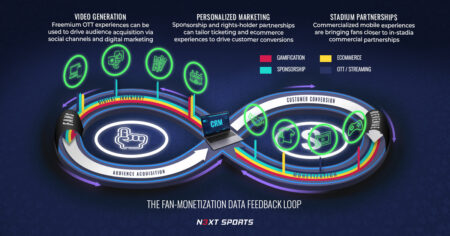
Omnichannel UX underutilized across European club football
Among sport’s digital pioneers, a higher majority of top-flight European football clubs showcase strong digital and data maturity levels compared to other sectors. According to N3XT Sports research for our 2025 Digital Trends in the Sports Industry report, football clubs which demonstrate high digital and data maturity, underpinned by a customer relationship management (CRM) solution or customer data platform (CDP), glean stronger commercial growth compared to clubs whose digital transformation is still in its infancy – broadly highlighting the value of owning a diverse D2C portfolio within a centralized, data-enabled ecosystem.
Speaking on the subject of data management in European football, Marcos Pelegrin, N3XT Sports Director of Commercial Services, says that, while Europe’s elite football clubs are “among the most digitally diverse in the sports industry”, going by N3XT Sports research, the football sector “could be working more effectively with their own data, particularly around audience acquisition and customer conversions […] using the data more effectively to better serve their commercial growth and processes.”
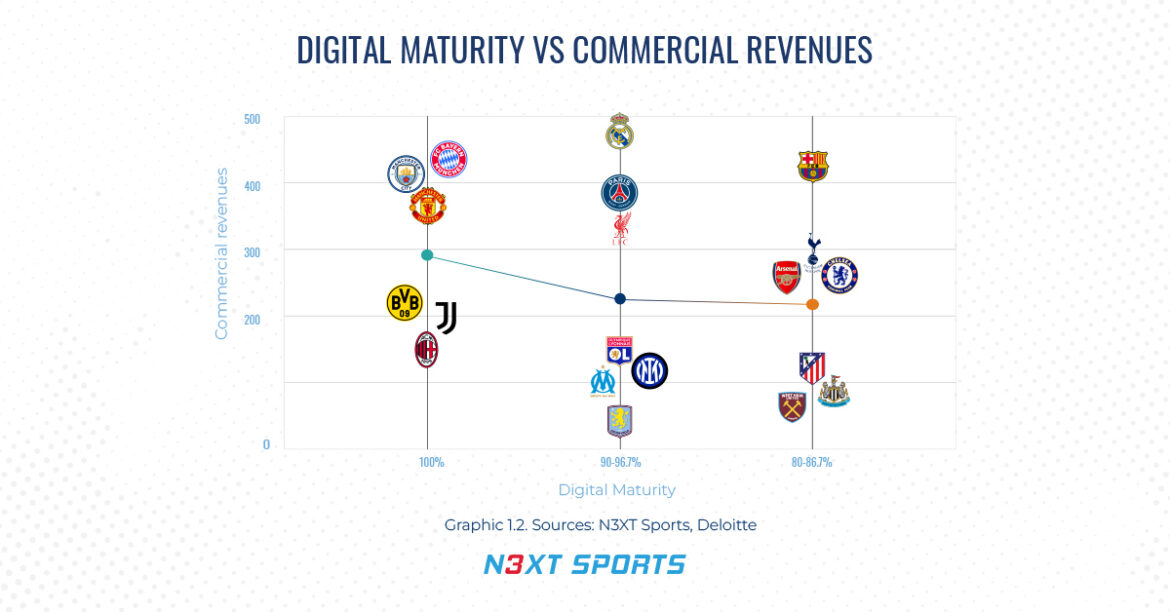 According to N3XT Sports’ latest research, using N3XT Sports’ unique research methodology, European club football’s highest commercial earners score higher for their digital and data transformations, whereas the vast majority centralize their fan-data collection via a single sign-on (SSO) and/or web login. However, while European football clubs are among the benchmarks within sport’s data revolution, as few as 35 percent of the clubs assessed centralize the fan experience via a fully integrated omnichannel experience. This also has a direct impact on both a club’s CRM and operational performance, according to our research.
For example, clubs which offer an omnichannel UX via mobile are also more likely to leverage artificial intelligence (AI) for measuring fan behaviors compared to those which do not. Meanwhile, the majority (60 percent) of Europe’s highest-earning clubs which integrate their entire data ecosystem – including athlete, fan, and business data – provide an omnichannel experience. This demonstrates a correlation between those clubs with a high data maturity and those which consolidate their digital inventory, while also highlighting benchmarks for commercial growth across the sector. Despite this foresight, many sports properties have yet to optimize their D2C portfolio to enhance their use of fan data and inform their commercial strategy.
Mobile integration a key milestone on digital transformation journey
There are many advantages to owning a dedicated mobile app in sports business, including the option for centralizing an organization’s D2C portfolio within an omnichannel fan experience. However, despite being a well-established feature throughout top-flight sport, including European club football, there are many clubs, leagues, and federations globally which do not collect first-party fan data via a dedicated mobile app, whereas many do not yet own a mobile product.
For example, the Olympic Movement is primed for digital growth. According to N3XT Sports research, as many as two in five (40 percent) International Federations (IF) in the Olympic Movement do not own a mobile app. Meanwhile, as many as three in five (60 percent) Olympic IFs do not collect fan data via mobile. This presents room for expanding mobile-audience engagement at federation level, while IFs which already own or are planning to implement a mobile product into their digital ecosystems hold the opportunity to optimize the customer journey by consolidating the UX.
N3XT Sports supports many organizations on their digital transformation journey. Notably, the Union Cycliste Internationale (UCI) appointed N3XT Sports to spearhead the implementation of the cycling federation’s integrated, mobile-friendly Information Management System (IMS), setting new standards for data management and operational excellence. N3XT Sports has also guided United World Wrestling’s (UWW) digital transformation journey, including the integration of UWW’s first-ever mobile app, CRM solution, and UWW+ streaming service via web and mobile. By creating a centralized UX, via an SSO, the Olympic wrestling governing body is able to connect its D2C portfolio to UWW’s wider digital ecosystem, bringing paying customers into UWW’s fan-marketing funnel.
Our team at N3XT Sports works tirelessly to develop and implement data and digital transformation strategies across a multitude of sports properties at federation level, competition level, and club level. To find out more about how N3XT Sports can serve your organization, fill out the form below, and we’ll be in touch. Our goal is to drive the digitalization of the sports industry and our clients.