

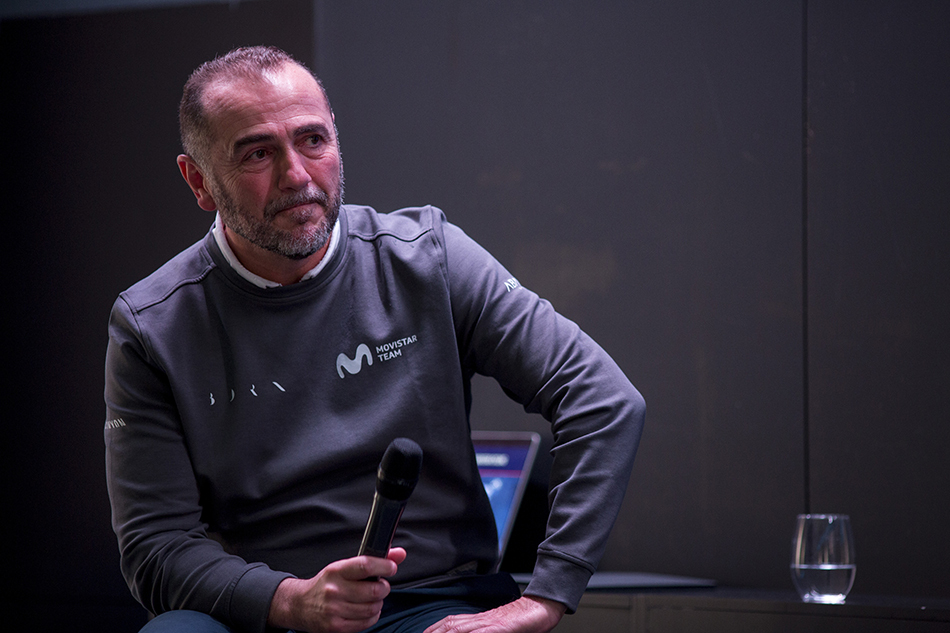
Miguel Grávalos, the CEO of Movistar Team Cycling and its management company Abarca Sports, last week joined a group of industry leaders at the N3XT Sports Annual Summit 2026, held at Movistar’s headquarters in central Madrid, to discuss the team’s long-term ambitions.
The conversation, led by Hisham Shehabi, OLY, the Chief Operating Officer (COO) and MENA lead for N3XT Sports, Movistar Team’s sports consultancy partner, reflects on a series of milestones shaping the team’s future over the next five years, including its growing global appeal among Movistar’s partners, riders and fans.
These include the launch of its Movistar Team Academy last year and the Movistar Team’s fresh approach to developing homegrown talent amid a competitive riders’ market. Miguel also discusses the significance of its partnership renewal with telco company Telefónica, through 2029, and how its long-term brand relationship is shifting in the age of digital fandom.
What is Movistar Team’s long-term vision?
:: For many years, our main issue was that we couldn’t think more than 2-3 years ahead. During recent years, we have had some key milestones which have changed that and allowed us to build a strategic plan for the next five years.
One of the changes was our renewal with Telefónica for five years, which is something exceptional in this sport. In parallel, it has changed the way we’re organized and reinforces our foundations and ability to develop a five-year plan that I am sure will bring good results to the team.
Every year, we build our marketing plan with all our sponsors and develop ideas with them based on what their strategy and goals are for the coming year. You shouldn’t be thinking about the sponsor as a brand that’s going to give you money at the end of every month. You have to go beyond that.
In the 47 years we have been on the UCI World Tour, we have had five main sponsors. This is important for me because the reason for this is our loyalty to them. It’s really important.
How does the investment model in cycling differ from other sports?
:: The economic model for a cycling team is quite special. Our income stream comes directly from our sponsors. We don’t have ticket or television rights – they are owned by the organizers. From that perspective, this is not a business where you can expect an immediate return – at least in the short term.
When I negotiate with our partners, I know what they expect from us with regards to visibility and I know what I need from them to help the team. That’s the reason why it is really tough to bring in investment in the case of cycling. We are talking about a company which invests, not only in cycling, but also other sports and leverages cycling as a way to link all their companies and employees.
How are you developing talent?
:: The reality is that, in the past five years, the cycling market has fluctuated a lot. There are huge differences between the budgets of the different teams. Given the situation, with the renewal with Telefónica and the entry of our new partners, we made the decision to launch our own academy team, something we previously did with our development team in the 1990s.
I have to link this to what we did in 2023; we had to change something because we couldn’t go to the [riders’] market. We decided to sign an agreement with the longest-lasting amateur team in Spain, Cafés Baqué, with the idea of tackling the challenge of developing talent.
The academy includes riders between 17-20 years old. By working with young riders, we are able to close the whole value chain rather than going out to the market. We decided to work towards the long-term and to help people to evolve inside the team and bring those young riders to the UCI World Tour.
How does Movistar Team market its activities globally?
:: The launch of the Netflix series The Least Expected Day: Inside the Movistar Team 2019 was a point when things really changed for us. Of course, we were well known in Spain. The focus then moved from being primarily in Spain and Europe, to one where people around the world recognize us and the team because of the documentary.
From our side and also for our partners, it’s completely changed what we do. The team moved from a European and Spanish team, to a global one, which helps a lot when attracting new partners. It shows the world that we’re here. We are a business with more than 150 workers. For us, while the performance side is what everyone sees, the production department is the one that develops stories and content for the market.
How has the value of the cycling market changed?
:: If we take into account that the goals and objectives of our sponsors have changed in recent years, they are looking for more from us as a partner. Five years ago, sponsors expected a return directly from our social media channels. I think, in football, this return on investment is around 3-4 times, whereas, in the case of cycling, it’s as much as 8-10 times. So, that side of the partnership is still really important.
We now help [our partners] to develop things they can use internally. Just as we adopt the values of cycling, we do the same for our partners. The way they see and work with sports is changing. For that reason, we have to change as well and to adapt. It’s not just about money and exposure. There are many other things we can offer.
How will the Movistar Team’s vision evolve in the coming years?
:: This new situation with our partners, and with Telefónica for the next five years, puts our focus, not only on the sporting and performance side, but also on the business side. Right now, we are fully aware that our company needs to deliver a return to our shareholders, but we also know that we are capable of developing more value in other lines of business.
One thing that cycling has in respect to other sports is that there are things that are exclusive to the sport. We are trying to make those things accessible and to generate new businesses. That includes a line of new experiences with the team, whereby our fans can come and stay with us. Those are things we are working on to offer something different and how we can support our sponsors. Our partners appreciate that a lot.
About N3XT Sports
N3XT Sports is a specialized sports industry agency focused on strategy, operations, and end-to-end data and digital transformation. Its team has delivered hundreds of projects across Europe, the Americas, and the Middle East, spanning sports commercialization, digital product development, data strategy, investments, competition formats, and performance.
With its operational HQ in Valencia, Spain, and a MENA office in Riyadh, Saudi Arabia, N3XT Sports helps rights holders, investors, and sports organizations redesign their business models for a data-native future.
N3XT Sports supports its clients at every stage of their digital transformation and strategy development. To find out more about how N3XT Sports can serve your organization and develop its very own tailor-made business strategy, fill out the form below, and we’ll be in touch. We look forward to hearing more about your journey.