


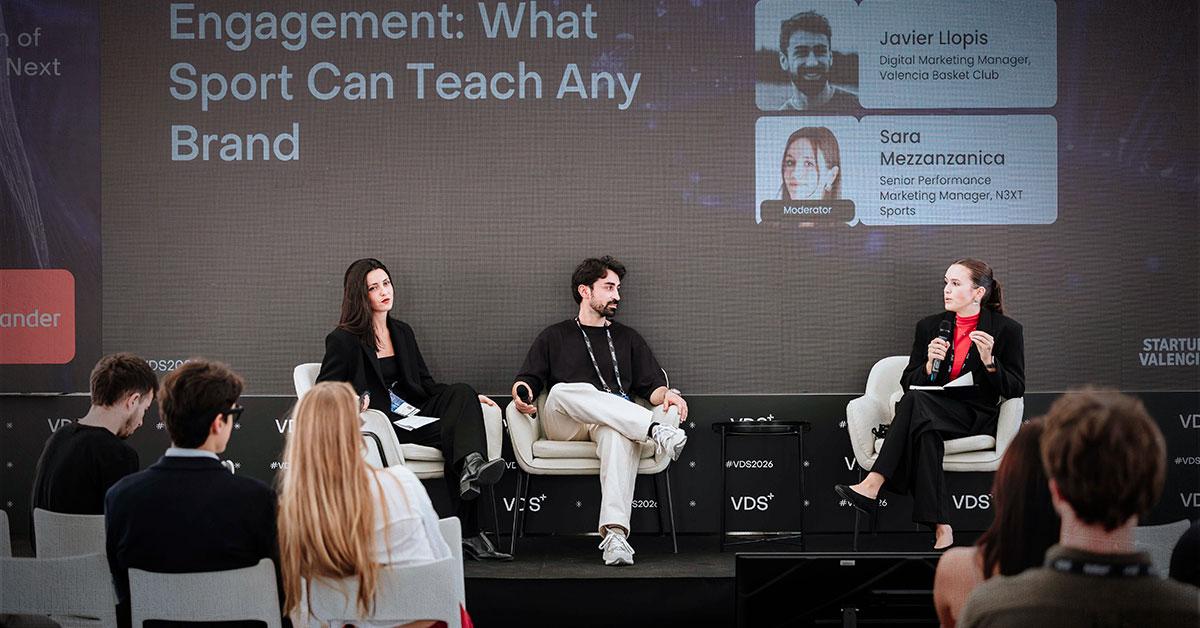
We were on the ground at the Valencia Digital Summit (VDS) last week, where N3XT Sports moderated a panel on one of the questions we hear most from sports properties and brands alike: how do you keep an audience engaged when there is no game to watch?
VDS 2026 ran on October 21–22 at the City of Arts and Sciences under the concept “GENESIS. Origin of What’s Next”. The ninth edition brought together more than 12,000 professionals from 120 countries, 3,000 startups and scaleups, over 1,500 corporations and around 800 international investors. AI ran through almost every stage. But sport, as it so often does, offered the clearest lessons for the rest of the room.
365 days of engagement: sport’s always-on advantage
Our panel, “365 Days of Engagement: What Sport Can Teach Any Brand”, brought together Ana Briz of Valencia CF and Javier Llopis Benavides of Valencia Basket Club. Two clubs from the same city, two different sports, one shared challenge: keeping a fan community active all year, not just on matchday.
The premise is simple. A season has an off-season, but a fan’s attention doesn’t switch off with it. Clubs that treat the gaps between fixtures as dead time hand that attention to someone else. Clubs that plan for them build habits, data and revenue that compound.
Three themes stood out from the conversation and from our work with rights holders:
- Community before content. Fans engage most when they feel part of something, not when they are simply served posts. The strongest programs give supporters a role: a voice, a ritual, a reason to come back.
- The calendar is the strategy. Pre-season, transfer windows, academy stories, community projects and city life all become content moments when planned in advance. An always-on plan fills the gaps before they appear.
- Every touchpoint should teach you something. Year-round engagement is only valuable if it feeds a single view of the fan. That is the logic behind our Fan-Data Feedback Loop™: capture, learn, personalize, repeat.
None of this is unique to sport. Any brand that wants loyalty rather than reach faces the same question. Sport simply has to answer it every week.
From always-on to always learning: the Fan-Data Feedback Loop™
Year-round engagement creates a steady stream of fan interactions. Most organizations never capture their full value, because the data is spread across ticketing, retail, social, apps and memberships. That fragmentation is one of the main barriers to return on digital investment in sport.
Our Fan-Data Feedback Loop™ is the framework we use to fix that. It turns engagement into a cycle in which every interaction makes the next one more relevant. It runs in three phases:
- Centralize the data. A scalable CRM or CDP brings fan data from every direct-to-consumer touchpoint into a single source of truth. Shared logins such as single sign-on (SSO) connect the ecosystem, and first-party data becomes an asset the organization owns.
- Personalize the experience. With one view of the fan, an omnichannel user experience can adapt to each supporter across app, web, email and venue. Bayern Munich’s app, for example, switches between matchday and non-matchday modes. Yet our research shows only around a quarter of Europe’s most digitally mature football clubs offer a mobile-enabled omnichannel experience.
- Optimize with AI. Once data is centralized and the experience is connected, AI can spot conversion trends and recommend the next best action for each fan. The Golden State Warriors draw on 30 customer data sources and more than 100 million data points to tailor their app to every user.
The order matters. AI only delivers useful fan insight once the data underneath it is organized. Organizations that skip straight to the shiny tools rarely see the return.
This is where the 365-day conversation and the loop meet. The off-season is not a pause in the loop; it is often the best time to run it. Lower content volume means cleaner signals, more space to test, and a chance to learn what fans want before the next season starts.
Carl Lewis and the gold medal mindset
The headline sports moment came on day one. Nine-time Olympic gold medalist and “World Athlete of the Century” Carl Lewis took the Main Stage for “The Gold Medal Mindset: Extreme Performance, Resilience, and Longevity in Leadership”.
Drawing on a career at the very top of athletics, Lewis spoke about leadership, resilience, competitive mindset and sustained performance, lessons aimed squarely at founders and business leaders facing growth and high-pressure decisions.
It is a useful frame for digital transformation in sport. The organizations that progress are rarely the ones with the biggest single launch. They are the ones that keep showing up, keep measuring and pick partners who help them get better between competitions.
Lewis was not the only athlete on the program. Former NBA player and basketball world champion Víctor Claver and UEFA Champions League winner César Azpilicueta spoke about investment, innovation and high performance, another sign of athletes stepping into the tech and investment conversation.
Startups, connections and the business signals
VDS 2026 closed with more than 30,000 business opportunities logged on its official platform, built from 6,444 meetings and 23,951 business connections.
The startup floor reflected where the wider tech market is heading: autonomous AI agents, robotics, biotech, defense and dual-use technology. Nanogrow, developing nanobody-based therapies, was named Best Startup of VDS 2026, and the summit used the stage to launch VDS Defense and Startup Valencia’s new International Advisory Board.
For sport, the signal is clear. The tools being built for other industries, from AI agents to personalization engines, are the same tools that will power the next generation of fan experiences. The rights holders that engage with these ecosystems early will shape how that technology fits sport, rather than retrofitting it later.
What it means for sports properties and brands
Across the panels, one idea kept returning: performance is a habit, not a moment. Carl Lewis said it about a 20-year athletic career. Our panel said it about fan communities. The startups on the floor said it about products that learn from every interaction.
For rights holders and the brands that partner with them, that translates into three priorities, each mapped to a phase of the Fan-Data Feedback Loop™:
- Own the relationship (Phase 1). Move fans from rented social audiences into owned channels such as CRM, apps and memberships, and centralize what you learn in one place.
- Plan for the gaps (Phase 2). Map the full 365-day calendar, not just the fixture list, and use one view of the fan to give every quiet period a personalized purpose.
- Let data close the loop (Phase 3). Use every interaction, and AI on top of clean data, to personalize the next one, so engagement gets smarter as the season goes on.
