

Twelve stages into the 2026 race, the more useful story isn’t who’s wearing yellow — it’s how a property with no box office keeps absorbing shocks that would break almost any other sports business.
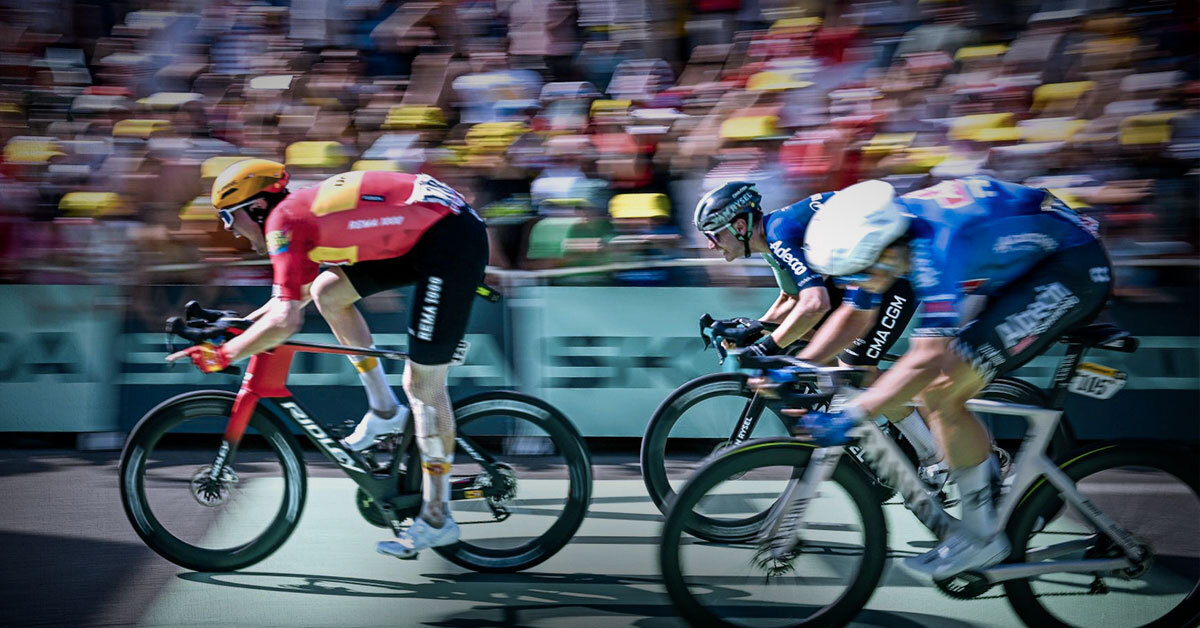
Most July coverage of the Tour de France tracks the same thing: who’s attacking, who’s cracking, who’s in yellow. This year that story belongs to Tadej Pogačar, who extended his overall lead with a dominant stage 10 win at Le Lioran on Bastille Day, days after a red-alert heatwave forced organizers to cut 30 kilometers from stage 9 mid-week. But from a sports business lens, the racing is almost beside the point. The Tour is one of the only global sports properties that sells zero tickets, and its handling of this year’s extreme heat is turning into a live stress test of just how resilient a diversified revenue model can be.
A Revenue Model Built Without A Box Office
Almost no other global sports property works this way: the Tour’s “venue” is thousands of kilometers of open road, and it generates no ticketing revenue at all. According to SportsPro’s analysis of the race’s business model, organizer ASO still pulls in more than €150 million — roughly $171 million — a year, built almost entirely on sponsorship, broadcast rights, and hosting fees paid by start and finish towns. Top-tier partner LCL has held naming rights to the yellow jersey since 1987, reportedly worth around $12 million annually, a partnership length few sponsorship deals in any sport can match. Lower down the commercial chain, Danish IT firm Netcompany’s reported €100 million naming-rights deal with Ineos Grenadiers shows the same staying power.
Why Cycling’s ROI Curve Looks Nothing Like Football’s
That durability traces back to a genuinely different economic structure — one worth hearing about from inside the sport rather than around it. As referenced in N3XT Sports’ interview with Movistar Team CEO Miguel Grávalos at its 2026 Annual Summit, Grávalos explained why cycling draws a different type of sponsor entirely: pro teams collect no ticketing or broadcast revenue of their own — those rights sit with race organizers — so a team’s entire income flows through its sponsors directly. Grávalos noted this makes cycling harder to pitch on short-term return, but more efficient once a partner commits, pointing to social-media return multiples of roughly 8 to 10 times investment in cycling, versus 3 to 4 times in football. It’s a structural reason cycling sponsorships tend to run longer and hold up better under disruption than deals in ticketed, broadcast-dependent sports.
How The Tour Stacks Up Against The Other Grand Tours
That gap looks even wider next to cycling’s other majors. As reported by GlobalData, the Giro d’Italia, the sport’s second-biggest race, generated an estimated $36.1 million in sponsorship revenue in its 2025 edition — down from $48.6 million the year before, as its sponsor count fell from 65 to 54. Its global broadcast rights, held by Discovery, run at roughly $18 million a year under a five-year, $90 million agreement. Set against the Tour’s estimated $171 million in annual revenue, per SportsPro, the gap shows just how concentrated cycling’s commercial value is in a single three-week property — and why the Tour functions as the sport’s economic reference point rather than one data point among several.
Broadcast Rights Are Consolidating, Not Fragmenting
While most sports properties are chasing fragmented streaming deals, the Tour’s broadcast rights have moved the other way. In the UK, Warner Bros. Discovery now holds exclusive live rights through TNT Sports and HBO Max, ending decades of free-to-air coverage on ITV, with Channel 5 kept on only for nightly highlights. In the US, NBC Sports and Peacock hold exclusive rights across every stage. Per SportsPro’s reporting, last year’s race drew close to 150 million viewers across Europe, including a record 45 million within France alone. For a rights holder, that consolidation trades reach for guaranteed value — a trade far easier to make with three weeks of daily inventory than with a single-day event.
This Year’s Live Stress Test: Heat As A Risk-Management Problem
The 2026 edition has handed that model an unplanned variable. Sustained temperatures above 35°C, and a red heatwave alert in the Corrèze department, pushed organizers to cut stage 9 from 185.5km to 155.5km and delay the start by about an hour — the first time this year extreme weather has directly altered a stage mid-week. Days later, Pogačar extended his overall lead on a shortened rest-day return at Le Lioran, with the heat still shaping team strategy around hydration and cooling. For a broadcaster or sponsor, a rerouted stage isn’t a footnote — it’s a live production and rights-exposure problem: start times shift, broadcast windows compress, and organizers have to make a safety call in real time without disrupting the commercial product running underneath it.
This is precisely the kind of scenario N3XT Sports’ Strategy & Consulting lead Eloi Pomé has flagged as an area where sports properties generally lag other industries. As he notes in N3XT Sports’ analysis of risk management in sport, 57% of organizations across sectors now build scenario planning and stress testing into their risk strategy — and firms with mature risk-management frameworks are 40% more likely to outperform competitors — yet sport as a sector still lacks the enterprise-level risk frameworks common in industries like energy or financial services. ASO’s ability to alter a stage mid-cycle without disrupting sponsor exposure or broadcast continuity is, in that light, a live demonstration of the scenario planning most sports properties are still building toward.
A Second Revenue Channel That Doesn’t Depend On A Broadcast Feed At All
Running alongside the broadcast product is a commercial channel that needs no live feed whatsoever: the Tour’s advertising caravan, active since 1930. As detailed by Sport Business Club, the 2026 procession includes on the order of 170 to 200 vehicles (estimates vary by source) representing 41 distinct brand activations, with new entrants this year including M&M’s, Procter & Gamble, and rail operator SNCF, the latter signing on as an official supplier through 2028. Independent of weather, broadcast windows, or who’s leading the race, the caravan is estimated to reach more than 12 million roadside spectators over the three weeks.
Hosting Fees Turn The Race Into A Public Investment Case
The same logic extends to how host regions treat the Tour. According to SportsPro, next year’s Grand Départ in the UK is backed by £32.5 million (about $43.4 million) in public funding, with the government forecasting roughly £150 million (about $200 million) in economic return — a multiple that positions hosting a stage not as a subsidy, but as a public-investment decision with a projected commercial payoff.
The Bigger Picture For Sports Business
Strip away the racing narrative, and the Tour’s real competitive advantage is structural: there’s no single point of commercial failure. A shortened stage barely dents the caravan’s reach or the jersey sponsors’ guaranteed daily visibility, and the model has been built — deliberately or not — around exactly the kind of disruption 2026 has delivered. It’s a useful reference point for any rights holder trying to work out how much of its own commercial model depends on one channel holding up, and how much would survive if it didn’t.
For more on how the summer’s biggest properties are competing for the same finite pool of attention, see N3XT Sports’ analysis of July 4’s unprecedented sports calendar congestion. And for a deeper look at how in-race disruption is reshaping fan engagement in real time, N3XT Sports’ ongoing Digital Maturity Index tracks the same dynamic across this summer’s World Cup.